MCP 2026-07-28: The Stateless Release Candidate, Explained
On May 21, 2026 the MCP maintainers locked the release candidate for the next protocol revision. It is the largest change since launch: the handshake is gone, the session id is gone, and any MCP request can now hit any server instance. Here is what shipped, what the SEPs actually say, and what to do before the spec finalizes on July 28.
On this page · 17 sections▾
- What's new in one line
- Why this release exists
- Mental model: five pillars
- Stateless core
- Operability: headers, caching, tracing
- Extensions, MCP Apps, Tasks
- Authorization hardening
- JSON Schema 2020-12
- Deprecations, not removals
- What we got wrong
- Migration mistakes to avoid
- Community signal
- What to do before July 28
- The verdict
- FAQ
- Glossary
- All sources
What’s new in one line
MCP 2026-07-28 removes the initialize handshake and the session id, turns extensions into a first-class framework, hardens OAuth against issuer mix-up, and ships a written deprecation policy — without removing any existing feature inside the 12-month window.
That sentence is the post. Every section below unpacks one phrase of it against the actual SEP text published by the MCP maintainers on the release candidate announcement.
Why this release exists
Two failure modes drove the redesign. First, the stateful handshake was incompatible with the way production HTTP is actually deployed: load balancers had to parse JSON-RPC bodies to route, sticky sessions blocked autoscaling, and a single server restart blew up every in-flight session. SEP-1442 — opened September 8, 2025 by Jonathan Hefner, Mark Roth, Shaun Smith, Harvey Tuch, and Kurtis Van Gent — framed this directly: “a simple stateless load balancer cannot be used, as it would route a client’s requests to different backend servers” without proper session state.
Second, the spec had collected a year of operational debt. There was no standard caching metadata, no standard tracing format, no formal deprecation policy, and extensions like Tasks lived “experimentally in the core spec” with no governance about how they would graduate or evolve. In April 2026, MCP co-creator David Soria Parra told ShiftMag that “2026 will be about making sure it’s ready to help people productionize agentic systems”. The release candidate is the technical answer to that statement.
The 2026 roadmap, published March 9, 2026, committed to four work areas: transport scalability, agent communication, governance maturation, and enterprise readiness. The release candidate maps directly onto those four: stateless core for the first, Tasks extension graduation for the second, deprecation policy and the Extensions Track for the third, MCP Apps and operability headers for the fourth.
Mental model: five pillars
The 21-plus SEPs in this release cluster into five load-bearing changes. Hold these in your head and the spec text becomes much shorter than it looks.
┌─────────────────────────────────────────────────────────┐
│              MCP 2026-07-28 — five pillars              │
├─────────────────────────────────────────────────────────┤
│  1. Stateless core      no handshake, no session id     │
│  2. Operability layer   routing headers, ttl, tracing   │
│  3. Extensions          MCP Apps + Tasks + framework    │
│  4. Auth hardening      6 SEPs aligning with OAuth/OIDC │
│  5. Deprecation policy  12-month window, written rules  │
└─────────────────────────────────────────────────────────┘
- Stateless core — SEP-2575 removes the initialize handshake, SEP-2567 removes the
Mcp-Session-Idheader. Protocol version, client info, and capabilities now travel on_metain every request. - Operability layer — required
Mcp-MethodandMcp-Nameheaders (SEP-2243), HTTP-style caching metadata (SEP-2549), and W3C Trace Context propagation (SEP-414). - Extensions framework — reverse-DNS-identified extensions negotiated via capability maps; MCP Apps (SEP-1865) and Tasks ship as the first two officials.
- Authorization hardening — six SEPs aligning MCP with mainstream OAuth 2.1 and OpenID Connect deployments, including iss-parameter validation per RFC 9207.
- Deprecation policy — SEP-2596 guarantees a minimum 12 months between deprecation and removal; SEP-2484 ties Standards Track SEPs to conformance suite scenarios before Final status.
Stateless core (SEP-2575 + SEP-2567)
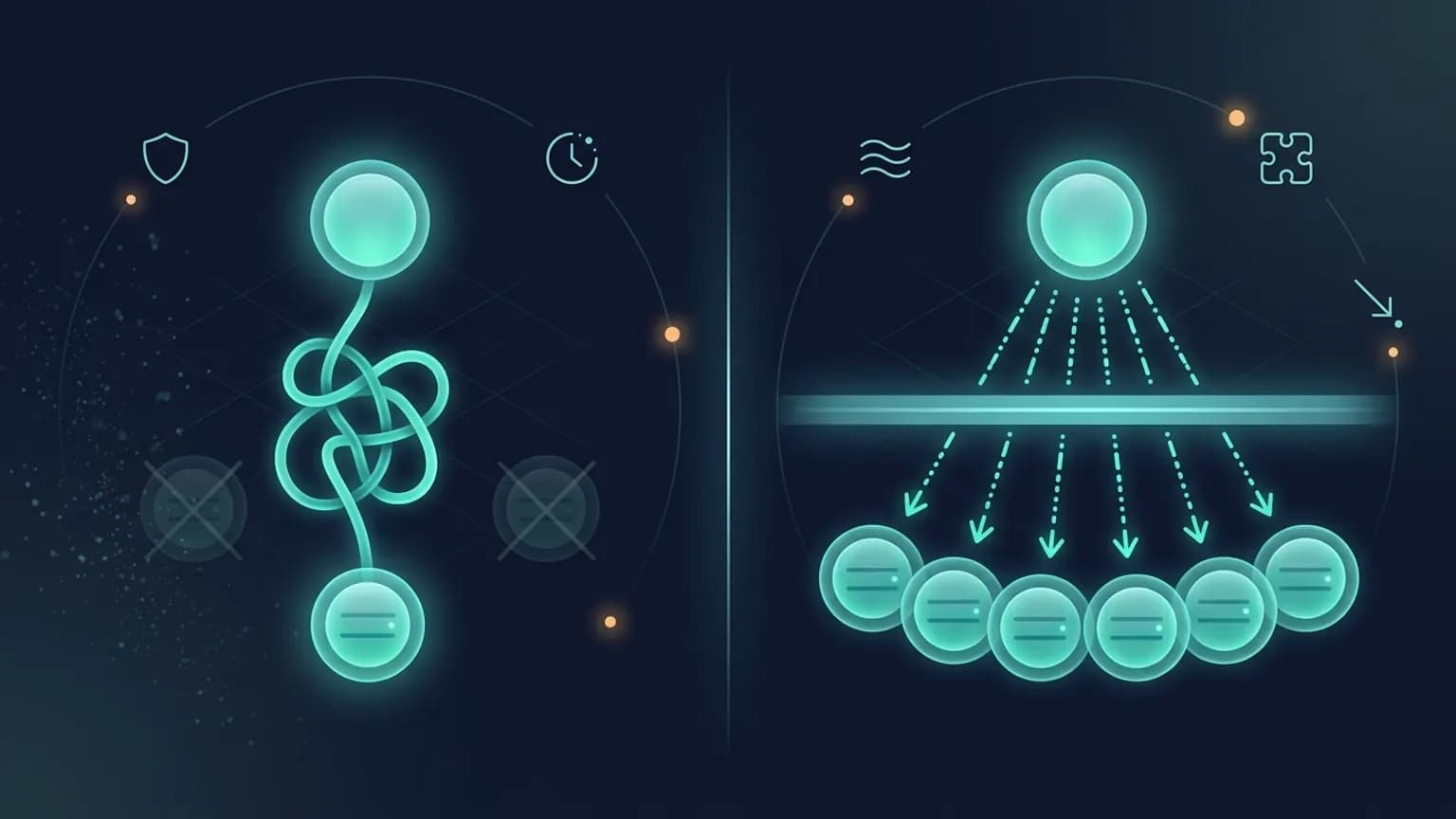
Before this release, every MCP session began with initialize from client to server, initialized back, and an Mcp-Session-Id header that all subsequent requests echoed. The server held that session in memory. If the session landed on a different replica later, things broke.
In 2026-07-28, that whole dance is gone. Every request carries its own protocol version, client identity, and negotiated capabilities inside the _meta object on the JSON-RPC envelope. Clients that need server capability discovery call a new server/discover method — stateless, cacheable, no shared state required. The release candidate puts the operational consequence plainly:
A remote MCP server that previously needed sticky sessions, a shared session store, and deep packet inspection at the gateway can now run behind a plain round-robin load balancer, route traffic on anMcp-Methodheader, and let clients cachetools/listresponses for as long as the server’sttlMspermits.
Server-initiated calls (the messages that used to require a long-lived SSE stream) move to a new Multi Round-Trip Requests pattern (SEP-2322). A server answers a tool call with an InputRequiredResult containing an inputRequests array and an opaque requestState. The client gathers the inputs, re-issues the call with inputResponses and echoes the same requestState back. The server reconstructs whatever it needs from requestState on its side — the protocol never holds a connection.
Opinion: this is the right call, even though it breaks SSE-based starter templates. The transport-future post from December 2025 named the principle: “agentic applications are stateful, but the protocol itself doesn’t need to be.” HTTP has worked this way for two decades. Cookies, tokens, opaque handles — application-layer state on a stateless wire is the pattern that scales.
Operability: headers, caching, tracing
Three SEPs in this cluster make MCP traffic indistinguishable, from a routing-and-observability standpoint, from normal HTTP API traffic. None of them are glamorous; all of them remove a class of production pain.
- Required headers (SEP-2243): every Streamable HTTP request must include
Mcp-Method(e.g.tools/call) andMcp-Name(the tool or resource name). Load balancers can route on these without parsing JSON-RPC bodies. - Caching metadata (SEP-2549):
tools/list,resources/list, andresources/readresults carryttlMsandcacheScopefields modeled on HTTPCache-Control. Clients now have a defined way to cache; servers have a defined way to invalidate. - Distributed tracing (SEP-414): W3C Trace Context propagation is documented with fixed
traceparent,tracestate, andbaggagekeys. OpenTelemetry collectors see MCP traffic end-to-end with no glue code.
Example: a routable MCP request after 2026-07-28
POST /mcp HTTP/1.1
Host: server.example.com
Authorization: Bearer <token>
Mcp-Method: tools/call
Mcp-Name: search_issues
Mcp-Protocol-Version: 2026-07-28
traceparent: 00-4bf92f3577b34da6a3ce929d0e0e4736-00f067aa0ba902b7-01

{"jsonrpc":"2.0","id":"req-1","method":"tools/call",
 "params":{"name":"search_issues","arguments":{"query":"crash"},
 "_meta":{"clientInfo":{"name":"claude","version":"3.5"}}}}
Opinion: the routing headers are the most underrated change in this release. Every gateway vendor at the AAIF MCP Dev Summit in April 2026 — Kong, Docker, Solo.io, Uber’s internal platform — was reverse-engineering tool names out of request bodies. That goes away on July 28.
Extensions, MCP Apps, Tasks
MCP gains a real extension system in this release. Extensions are identified by reverse-DNS IDs, live in their own ext-* repositories with their own maintainers, and are negotiated through an extensions map on the client and server capability advertisements. They version independently of the core spec. The SEP process now has an explicit Extensions Track.
Two extensions ship official on day one.
MCP Apps (SEP-1865)
Servers can declare an HTML interface that clients render inside a sandboxed iframe. Tools declare which UI templates they use ahead of time so the client can prefetch them and security-review them. The rendered UI talks back to the server via the same JSON-RPC protocol the tool does — no new wire format. This is the spec layer that competes directly with OpenAI’s Apps SDK.
Tasks (migrated from experimental core)
Tasks moved out of the core spec and into an extension, and the design was reshaped around the new stateless model. A server now answers tools/call with a task handle. The client drives the task via tasks/get, tasks/update, and tasks/cancel. Task creation is server-directed (the server decides what to make a task and what to answer inline). The release candidate notes tasks/list was removed because listing tasks across clients without sessions has no well-defined scope.
Opinion: the extensions framework is the second most-important change in this release, after the stateless core. It is the governance answer to the long tail of feature requests — rich UIs, durable jobs, agent handoff — that do not belong in a wire specification. The lesson from the Language Server Protocol that inspired MCP is that the spec stays useful only if its evolution surface is bounded.
Authorization hardening
Six SEPs land in this release, each fixing a sharp edge in MCP’s OAuth 2.1 deployment story.
- SEP-2468: clients must validate the
issparameter on every authorization response per RFC 9207 to mitigate mix-up attacks where one authorization server’s response is replayed against another. - SEP-837: MCP clients now declare an OpenID Connect
application_typeduring Dynamic Client Registration. Most OIDC providers refuse DCR without it; the spec used to leave the field empty. - SEP-2352: registered client credentials are bound to the authorization server’s
issuer. If the server changes issuers, the client re-registers. - SEP-2207: refresh-token requests are clarified for OpenID-Connect-style providers (the older spec was ambiguous about
scopesemantics on refresh). - SEP-2350: scope accumulation during step-up authentication is now defined — previously every implementation rolled its own.
- SEP-2351: well-known discovery uses a stable suffix so resource and authorization metadata documents always live at predictable paths.
Opinion: SEP-2468 is the one that should ship in every client by August. Mix-up attacks against OAuth-protected APIs have been weaponized in the wild since at least 2016. Treating MCP servers as protected resources means MCP clients inherit the same threat model — and the exploitation cost is low because the surface is small.
JSON Schema 2020-12 support
SEP-2106 upgrades tool inputSchema and outputSchema to JSON Schema draft 2020-12. The headline unlocks:
- Input schemas keep a
type: "object"root, but composition (oneOf,anyOf,allOf), conditionals (if/then/else), and$ref/$defsare now allowed. Tools that genuinely have polymorphic parameters can express it. - Output schemas are unrestricted — no more forcing every tool response into an object wrapper.
structuredContentcan be any JSON value, not just objects.- Auto-dereferencing external
$refURIs is prohibited, and validators must bound schema depth and time. These are denial-of-service guards.
One smaller error-code change worth knowing: SEP-2164 replaces the MCP-custom -32002 “missing resource” code with JSON-RPC’s standard -32602 Invalid Params. Servers that hard-coded -32002 will continue to be interpreted correctly by clients during the deprecation window, but generic JSON-RPC tooling now works without an MCP-specific code table.
Deprecations, not removals
The release candidate is firm on this point: no feature is removed in 2026-07-28. Three are deprecated with replacements documented. Per the new lifecycle policy (SEP-2577 + SEP-2596), Active → Deprecated → Removed transitions take a minimum of 12 months.
| Feature | Replacement |
|---|---|
roots | Tool parameters, resource URIs, or server configuration |
sampling | Direct LLM provider API integration |
logging | stderr for stdio; OpenTelemetry for structured observability |
Methods, types, and capability flags keep functioning in this release and in every spec version published inside the 12-month window. SDK code that calls roots/list on July 29 will still get a valid response.
What we got wrong reading the draft
Three things I assumed before reading the SEPs carefully — and was wrong about.
1. I thought stateless meant Streamable HTTP was dead. It is not. Streamable HTTP is still the transport. What changed is that the request lifecycle no longer requires the connection to be the unit of session. A client can open and close connections per request, or multiplex many requests over one connection — either works because no session state is bound to either. Streamable HTTP without the session id is still streamable HTTP.
2. I thought MCP Apps replaced the tool/resource pair. They do not. MCP Apps is an extension that augments a tool with a rendered surface, the way a Stripe webhook UI augments a Stripe API. The tools still exist, still take JSON arguments, still return JSON results. The app is the optional interactive shell on top.
3. I assumed the deprecation policy would slow velocity. The opposite. The lifecycle policy makes it safer to deprecate, because the 12-month guarantee removes the political cost of saying “we no longer recommend X.” The transport-working-group history showed that removing things informally generated months of community thrash. Writing it down turns deprecation into a routine operation.
Migration mistakes to avoid
Storing session state in the server process
Root cause: porting a stateful 2025-11-25 server without rethinking persistence. The new contract expects you to externalize anything you cared about per-session — basket id, browser id, workflow handle — into a tool-minted opaque handle the client passes back.
Ignoring the routing headers because “the body has the same info”
Root cause: the routing headers are required, not optional. Gateways that validate Streamable HTTP traffic will reject requests missing Mcp-Method or Mcp-Name. If your client SDK is older, regenerate.
Mishandling requestState
Root cause: treating requestState as a secret or as something the client can interpret. It is opaque to the client, but it is not a secret. The server signs or encrypts whatever needs to survive a round-trip; the client echoes it verbatim. Treating it like a session id reintroduces the very problem the redesign removed.
Rushing to remove deprecated features
Root cause: confusing “deprecated” with “removed.” Sampling, roots, and logging keep working in every spec published inside the 12-month window. Don’t break your server’s API surface on the day the spec finalizes — migrate at the SDK’s pace.
Community signal
The maintainer summary, posted by David Soria Parra on the day the release candidate was announced:
The release candidate for MCP 2026-07-28 is out. The protocol is now stateless: no handshake, no session id, any request can hit any server instance. Plus extensions as first-class (MCP Apps, Tasks), auth hardening, and a proper deprecation policy so we don’t have to do this…
— David Soria Parra (@dsp_) May 22, 2026
That is the maintainer’s framing. The contrarian view came earlier in the cycle. At the AAIF MCP Dev Summit in April 2026, Uber’s platform team — running tens of thousands of agent executions a week through their internal MCP gateway — argued that protocol changes alone wouldn’t solve their problems: gateways and registries do most of the real work, and the protocol is the layer that gets in their way least. The stateless redesign is that team’s argument winning.
The harder critique is older but unresolved: David Soria Parra himself, interviewed in April 2026, called out a separate failure mode the protocol does not yet address. “Tools come with metadata: descriptions, parameters, schemas. Across dozens of integrations, a significant portion of the context window is consumed before the model does any actual reasoning,” he told ShiftMag. Stateless transport doesn’t fix context bloat. That fight stays in the client layer.
On Hacker News, the long-standing structural criticism of MCP — that the stateful design fought with load balancers, complicated horizontal scaling, and forced harnesses to manage connection lifecycle — gets answered by this release. The stateless redesign is, almost line for line, the pattern those threads asked for.
What to do before July 28
The release candidate is locked. The spec text can still change if blocking issues surface during the 10-week window, but the architectural shape is final. A practical week-by-week:
- Now: read the draft spec. Identify which of your servers hold session state and where you would externalize it. Audit your auth code against the six auth SEPs.
- June: rebuild against the RC SDKs as they land. Verify the routing headers are sent by your client of choice (Claude Desktop, Cursor, Claude Code, VS Code, ChatGPT). Run your servers against the conformance scenarios SEP-2484 references.
- July: deploy a stateless variant of any remote MCP server you operate, behind a plain HTTP load balancer. Measure: does it autoscale? Does a rolling deploy break in-flight tool calls? Multi Round-Trip is the right answer if you previously held connections open.
- July 28+: when the spec ratifies, flip your servers’ declared protocol version to
2026-07-28. Keep the deprecated features functional; do not remove them for at least 12 months.
The verdict
Our take
2026-07-28 is the release that turns MCP from a prototype-friendly protocol into one you can run at scale on infrastructure that already exists. The stateless redesign, routing headers, caching metadata, and tracing keys close the operational gap with mainstream HTTP APIs. The extensions framework solves the governance problem of where to put features that don’t belong in a wire spec. The deprecation policy makes future change cheaper.
Migrate at the SDK’s pace; nothing in this release forces a hot cut-over. Read the auth SEPs this week regardless — SEP-2468 (iss validation per RFC 9207) is the one most likely to be exploited in the wild between now and July 28.
Frequently asked questions
Is the 2026-07-28 spec breaking for existing MCP servers?
Yes at the protocol layer, no at the feature surface. The initialize handshake and Mcp-Session-Id header are removed, so transport code changes. But roots, sampling, and logging are deprecated rather than removed and continue to work for at least 12 months. Existing tools, resources, and prompts keep working.
When does the 2026-07-28 specification become final?
July 28, 2026. The release candidate was locked on May 21, 2026, opening a 10-week window for SDK validation, conformance tests, and feedback before the spec ratifies. Spec text can still change during this window if blocking issues surface.
What is SEP-2575 and why does it matter?
SEP-2575 is the proposal that removes MCP's initialize/initialized handshake. Combined with SEP-2567 (which deletes session ids), it makes the protocol truly stateless: any request can hit any server instance. The practical effect is that you can run MCP behind a plain round-robin load balancer without sticky sessions.
Do I have to migrate my server immediately?
No. The 2025-11-25 specification keeps working, and clients are expected to support both wire formats during the transition. The deprecation policy adopted in this release (SEP-2596) guarantees a minimum 12-month overlap between deprecation and removal of any feature.
What happens to roots, sampling, and logging?
All three are deprecated but still functional. The replacements: tool parameters or resource URIs for roots, direct LLM API integration for sampling, stderr or OpenTelemetry for logging. The spec keeps them callable for at least 12 months from publication so SDKs can migrate without breaking existing servers.
What are MCP Apps?
MCP Apps (SEP-1865) is the first official MCP extension. It lets a server ship an HTML interface that the client renders inside a sandboxed iframe and communicates with via JSON-RPC. Tools declare their UI templates ahead of time so clients can prefetch and security-review them.
Why JSON Schema 2020-12 instead of the older draft?
SEP-2106 adopts JSON Schema 2020-12 for tool inputSchema and outputSchema. This unlocks composition (oneOf, anyOf, allOf), conditionals, and $ref/$defs. Auto-dereferencing external $ref URIs is still prohibited and schema depth must be bounded — both are denial-of-service guards.
Glossary
Stateless protocol
Every request carries its own version, identity, and capabilities. No shared session state on the server.
_meta
JSON-RPC envelope field MCP uses to carry protocol version, client info, and capabilities per request.
server/discover
New RPC method clients call to fetch a server's capabilities. Cacheable, no shared state.
Multi Round-Trip (SEP-2322)
Pattern where servers return InputRequiredResult; clients re-issue with inputResponses and echoed requestState.
Mcp-Method header
Required Streamable HTTP header naming the JSON-RPC method (e.g. tools/call). Used by load balancers to route.
ttlMs / cacheScope
Caching metadata on list and read results, modeled on HTTP Cache-Control.
traceparent
W3C Trace Context header MCP now propagates by default. OpenTelemetry-compatible.
Extension
Reverse-DNS-identified, independently versioned add-on negotiated via the extensions capability map.
MCP Apps (SEP-1865)
Official extension: servers ship HTML rendered in a sandboxed iframe, communicating via JSON-RPC.
Tasks
Official extension for long-running work. Server-directed creation; client drives via tasks/get, /update, /cancel.
SEP
Specification Enhancement Proposal. MCP's RFC equivalent. Tracks: Standards, Extensions, Process.
Deprecation window
Minimum 12 months between marking a feature deprecated and removing it. Guaranteed by SEP-2596.
All sources
Primary
- The 2026-07-28 MCP Specification Release Candidate — David Soria Parra and Den Delimarsky, MCP Blog, May 21, 2026.
- The 2026 MCP Roadmap — MCP Blog, March 9, 2026.
- Exploring the Future of MCP Transports — MCP Blog, December 19, 2025.
- SEP-1442: Make MCP Stateless (by default) — original proposal, September 8, 2025.
- Model Context Protocol Specification — Draft — the spec text under review.
- MCP Specification Releases — full revision history (2024-11-05 → 2025-11-25 stable).
- Specification Enhancement Proposals index.
- RFC 9207 — OAuth 2.0 Authorization Server Issuer Identification (referenced by SEP-2468).
Community & press
- David Soria Parra @dsp_ — announcement tweet, May 22, 2026.
- AAIF’s MCP Dev Summit: Gateways, gRPC, and Observability Signal Protocol Hardening — InfoQ, April 9, 2026.
- MCP co-creator David Soria Parra on What Breaks MCP at Scale — ShiftMag, April 16, 2026.
Internal
- What is the Model Context Protocol? A Developer’s Map — the foundational explainer.
- MCP Apps vs OpenAI Apps SDK — the rival UI standard SEP-1865 codifies.
- Browse 3,000+ MCP servers
- Best MCP servers
- Remote (hosted) MCP servers — the deployments most affected by stateless routing.
- Claude Desktop, Cursor, VS Code, Claude Code — client guides.