
API.market
OfficialProvides access to over 200 APIs from API.market including image generation, geocoding, and content detection through a unified authentication system. Converts OpenAPI specifications into MCP tools that can be used directly by language models.
Converts OpenAPI specifications from API.market into tools for accessing over 200 services including image generation, geocoding, and content detection through a unified authentication system
What it does
- Generate images using various AI models
- Geocode addresses and locations
- Detect and analyze content
- Access 200+ different web APIs
- Execute API calls with unified authentication
- Browse available API specifications
Best for
About API.market
API.market is an official MCP server published by noveum that provides AI assistants with tools and capabilities via the Model Context Protocol. API.market offers seamless API integration and API to API integration, making access to over 200 services like Stripe API and API LinkedIn easy. It is categorized under developer tools.
How to install
You can install API.market in your AI client of choice. Use the install panel on this page to get one-click setup for Cursor, Claude Desktop, VS Code, and other MCP-compatible clients. This server runs locally on your machine via the stdio transport.
License
API.market is released under the MIT license. This is a permissive open-source license, meaning you can freely use, modify, and distribute the software.
API-MARKET MCP Server
About
A Model Context Protocol (MCP) server that exposes API-Market's endpoints as MCP resources. This server allows Large Language Models to discover and interact with APIs defined by OpenAPI specifications through the MCP protocol.
This repository provides access to the APIs available at API.market. The tool is free to use and allows agents to communicate freely with all available APIs, making it super powerful. With over 200+ APIs available at API.market, you can leverage a wide range of functionalities.
Quick Start
You do not need to clone this repository to use this MCP server. You can simply configure it in your client of choice.
For Claude Desktop
- Locate or create your Claude Desktop configuration file:
- On macOS:
~/Library/Application Support/Claude/claude_desktop_config.json
- On macOS:
- Add the following configuration to enable the API-Market MCP server:
{
  "mcpServers": {
    "api-market": {
      "command": "npx",
      "args": ["-y", "@noveum-ai/mcp-server"],
      "env": {
        "API_HEADERS": "x-magicapi-key:your-api-key"
      }
    }
  }
}
For Cursor
- Go to File -> Preferences -> Cursor Settings.
- Select MCP.
- Click on Add new global MCP Server.
- Paste the following into the mcp.json file.
  {
    "mcpServers": {
      "api-market": {
        "command": "npx",
        "args": [
          "-y",
          "@noveum-ai/mcp-server",
          "--headers",
          "x-magicapi-key:<your-api-key>"
        ]
      }
    }
  }
Alternatively, add this as the first entry in mcpServers.
    "api-market": {
      "command": "npx",
      "args": [
        "-y",
        "@noveum-ai/mcp-server",
        "--headers",
        "x-magicapi-key:<your-api-key>"
      ]
    },
- For older versions of Cursor, add the following command after clicking on Add new MCP server
npx -y @noveum-ai/mcp-server --headers x-magicapi-key:your-api-key
Getting an API Key from API.market
To obtain an API key
- Log in to API.market
- Go to your profile and select 'My API Keys'
- Your API keys will be displayed here
List of APIs in this MCP
- GET-trueway-matrix-MatrixService-CalculateDrivingMatrix
- GET-magicapi-whisper-predictions--request_id
- POST-magicapi-whisper-whisper
- POST-capix-faceswap-upload
- POST-capix-faceswap-faceswap-v1-image
- POST-capix-faceswap-faceswap-v1-video
- POST-capix-faceswap-result
- GET-trueway-geocoding-GeocodingService-Geocode
- GET-trueway-geocoding-GeocodingService-ReverseGeocode
- POST-magicapi-dnschecker-dnschecker
- GET-magicapi-coder-predictions--request_id
- POST-magicapi-coder-coder
- POST-bridgeml-nsfw-detection-nsfw_detection
- GET-magicapi-whois-whois--domain-
- GET-magicapi-deblurer-predictions--request_id
- POST-magicapi-deblurer-deblurer
- POST-bridgeml-text-to-image-text_to_image
- GET-magicapi-period-predictions--request_id
- POST-magicapi-period-period
- GET-trueway-places-PlacesService-FindPlaceByText
- GET-trueway-places-PlacesService-FindPlacesNearby
- GET-magicapi-hair-predictions--request_id
- POST-magicapi-hair-hair
- POST-bridgeml-codellama-bridgeml-codellama
- GET-brave-brave-videos-search
- GET-brave-brave-web-search
- GET-brave-brave-images-search
- GET-brave-brave-news-search
- GET-brave-brave-suggest-search
- GET-brave-brave-spellcheck-search
- POST-magicapi-domainchecker-check_domains
- GET-trueway-routing-DirectionsService-FindDrivingRoute
- GET-trueway-routing-DirectionsService-FindDrivingPath
- POST-pipfeed-parse-extract
Example and Usage
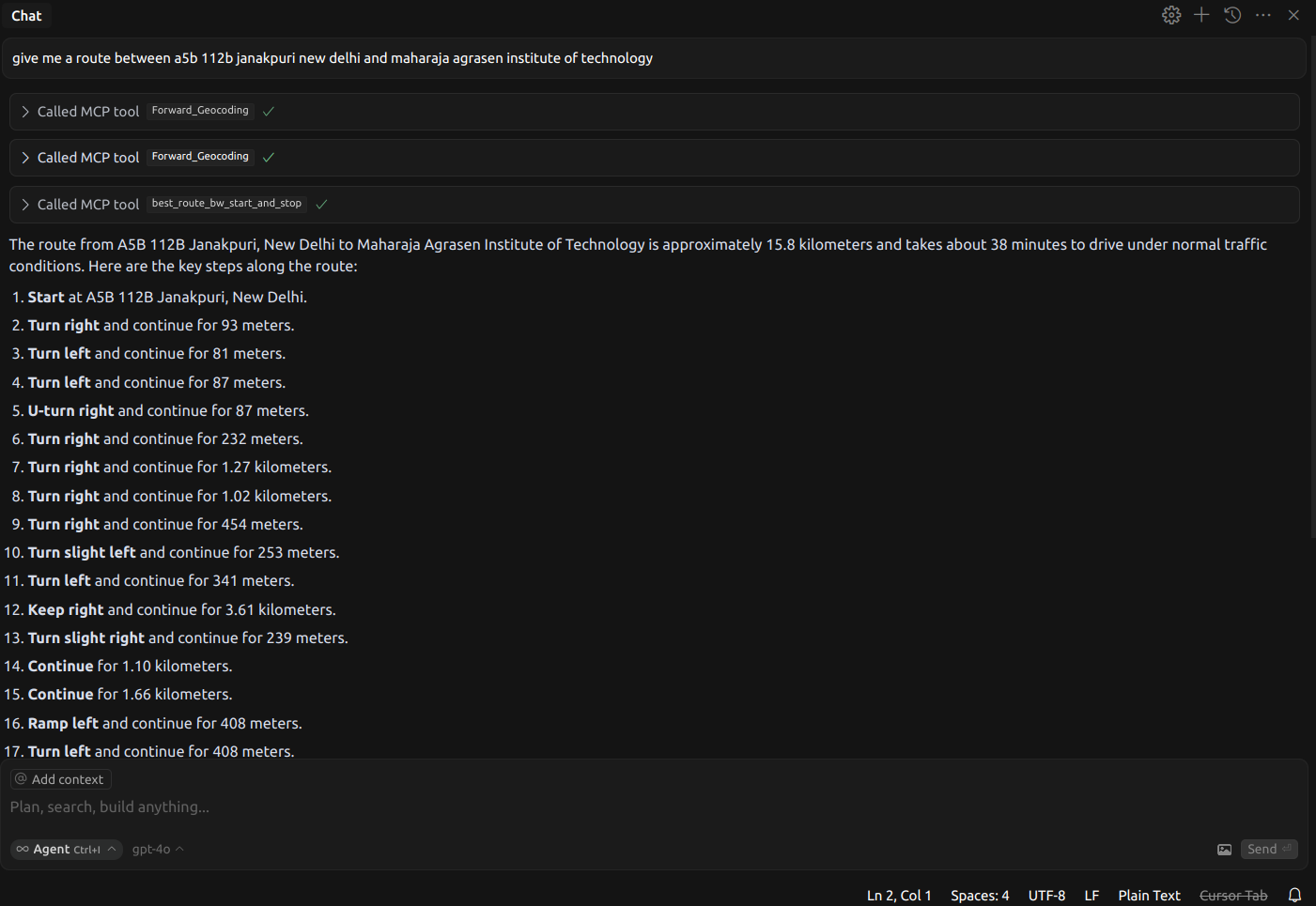
Example 1
We can use the agent to find a route between any two points
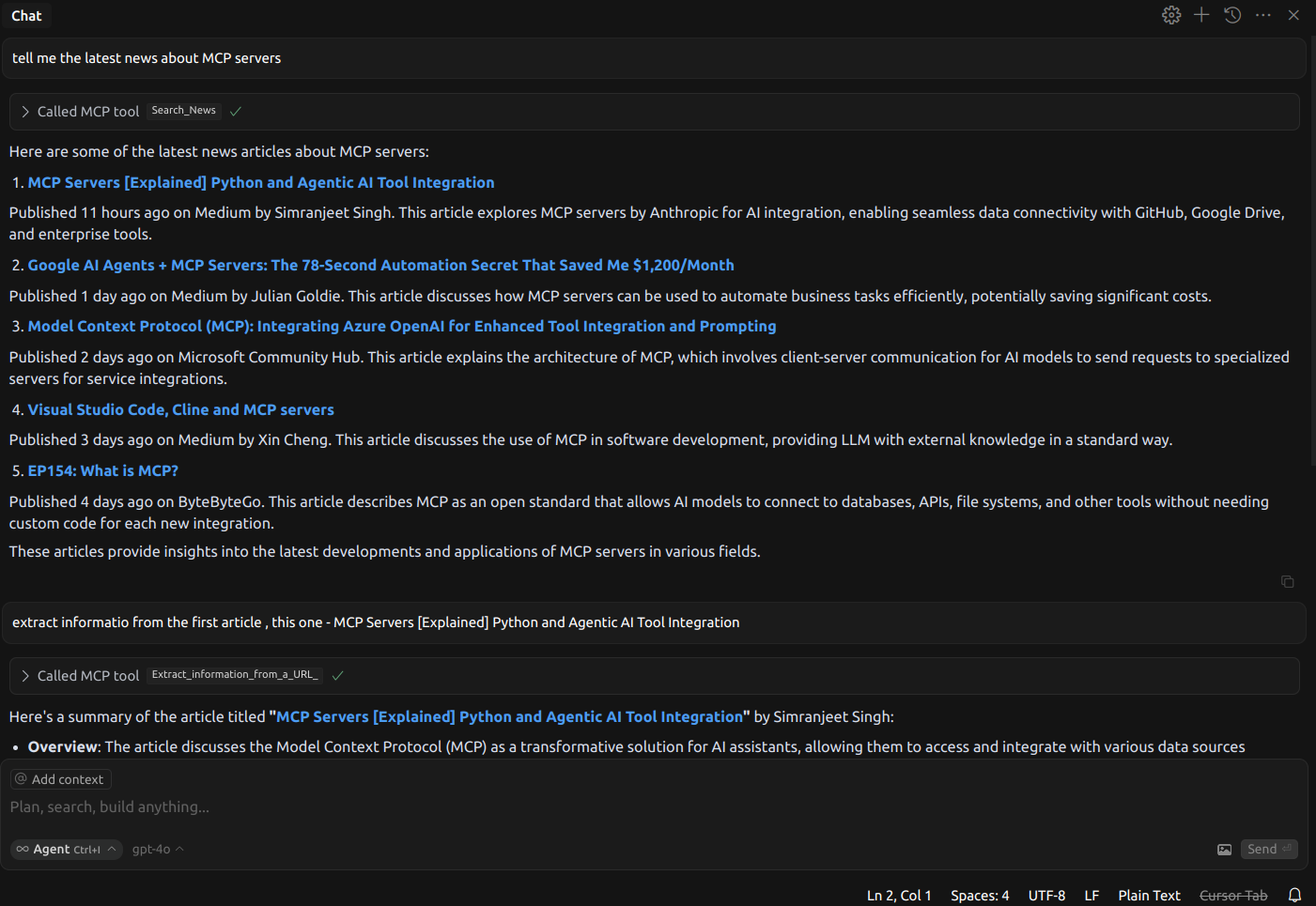
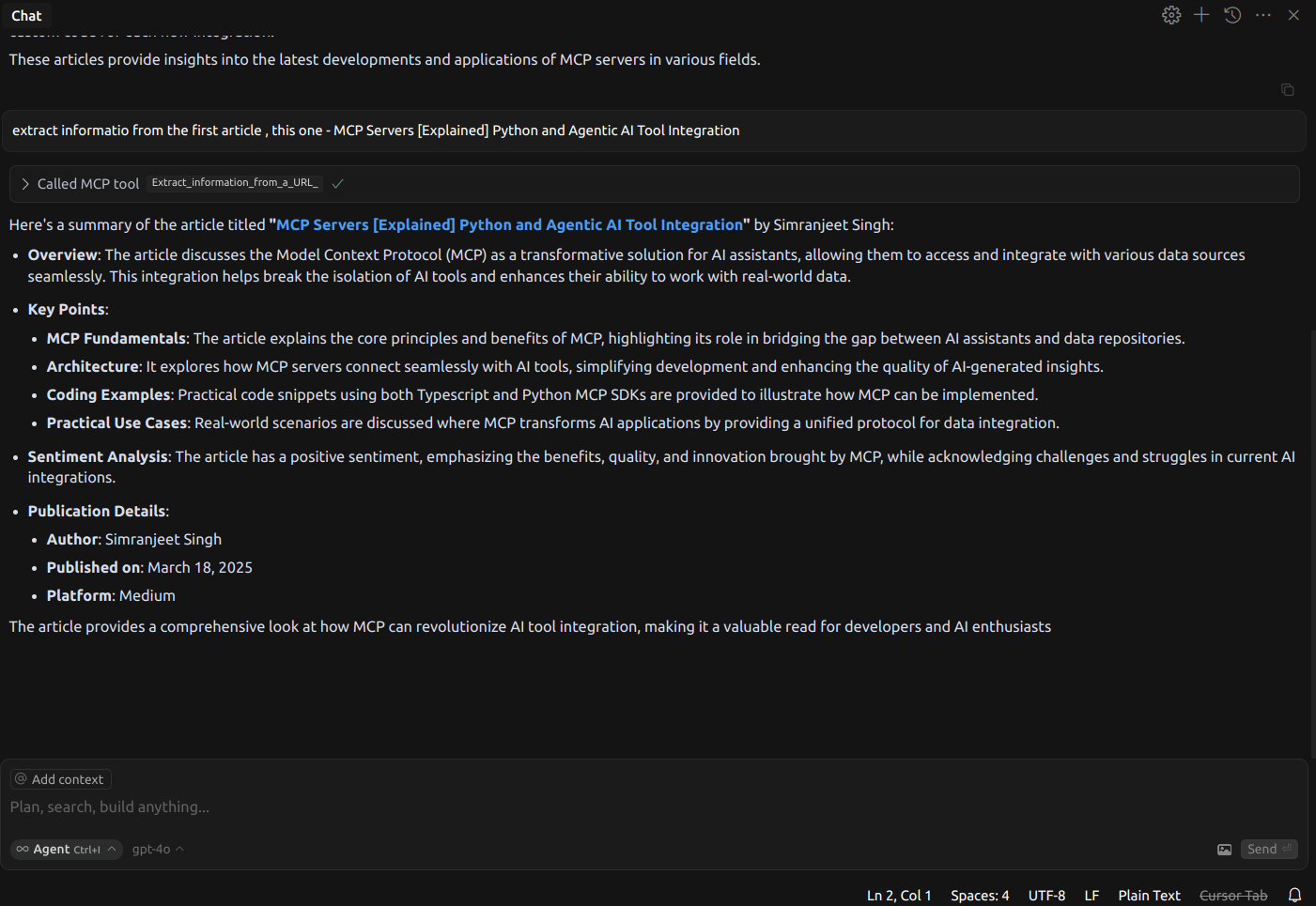
Example 2
We can use the agent to find news about any topic, and then dig deeper into the articles
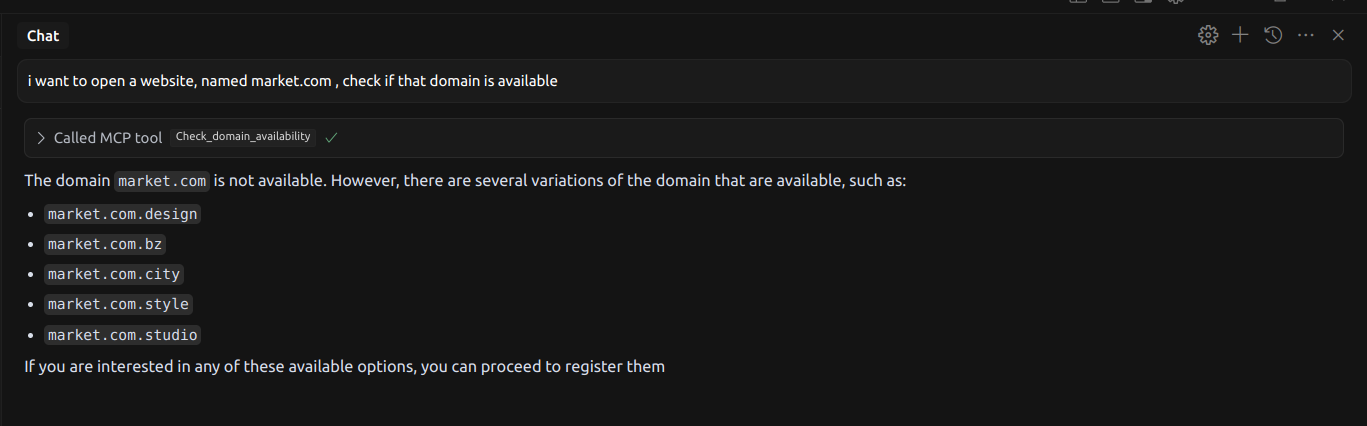
Example 3
We can use the agent to look for available domains
Development
Adding a New API to the MCP Server
The utils folder contains helper scripts for managing API configurations, parsing OpenAPI specifications, and registering new APIs into the MCP server.
1. Locate the OpenAPI Specification
Find the OpenAPI JSON for the API you want to integrate. After that, create a folder json_files in the root directory of the project and add your OpenAPI JSON spec to the folder
2. Modify the OpenAPI Specification
After obtaining the OpenAPI spec, use modify_api.py to update the path inside the spec to include the file name.
python utils/modify_api.py
3. Update API Summaries
After modifying the paths, update the API summaries by choosing one of the following options:
- Automatically shorten summaries using an LLM:
python utils/LLM_summary_shortener.py
- Manually update the summaries:
python utils/manual_summary_shortener.py
4. Build and Test
Rebuild the project to apply the changes:
npm run build
Then, test the new API integration using:
npm run inspect
5. Submit Your Changes
If you want to contribute this new API to the repository:
- Fork the repo.
- Create a branch.
- Submit a pull request (PR).
6. Publish the MCP server (Optional)
If you want to publish your changes:
- Update the
package.jsonaccordingly (e.g., update the version, name, etc.). - Publish the package:
npm publish --access public
Development Tools
Building
npm run build- Builds the TypeScript source.npm run clean- Removes build artifacts.npm run typecheck- Runs TypeScript type checking.
Development Mode
npm run dev- Watches source files and rebuilds on changes.npm run inspect-watch- Runs the inspector with auto-reload on changes.
Code Quality
npm run lint- Runs ESLint.npm run typecheck- Verifies TypeScript types.
Command Line Arguments
npm run inspect -- \
  --api-base-url https://api.magicapi.dev/api/v1/ \
  --openapi-spec modified_files.txt \
  --headers "x-magicapi-key:your-api-key" \
  --name "my-mcp-server" \
  --version "1.0.0"
Development Workflow
- Start the development environment:
npm run inspect-watch
- Modify the TypeScript files in
src/. - The server will automatically rebuild and restart.
- Use the MCP Inspector UI to test your changes.
Debugging or Running Locally
To debug or run the MCP server locally:
- Clone the repository and install dependencies:
git clone https://github.com/Noveum/api-market-mcp-server.git
cd api-market-mcp-server
npm install
- Build the server:
npm run build
- For debugging, you can run:
npm run inspect
Contributing
- Fork the repository.
- Create a feature branch.
- Make your changes.
- Run tests and linting:
npm run typecheck
npm run lint
- Submit a pull request.
License
MIT
Alternatives



Related Skills
Browse all skillsUI design system toolkit for Senior UI Designer including design token generation, component documentation, responsive design calculations, and developer handoff tools. Use for creating design systems, maintaining visual consistency, and facilitating design-dev collaboration.
Answer questions about the AI SDK and help build AI-powered features. Use when developers: (1) Ask about AI SDK functions like generateText, streamText, ToolLoopAgent, embed, or tools, (2) Want to build AI agents, chatbots, RAG systems, or text generation features, (3) Have questions about AI providers (OpenAI, Anthropic, Google, etc.), streaming, tool calling, structured output, or embeddings, (4) Use React hooks like useChat or useCompletion. Triggers on: "AI SDK", "Vercel AI SDK", "generateText", "streamText", "add AI to my app", "build an agent", "tool calling", "structured output", "useChat".
Use when working with the OpenAI API (Responses API) or OpenAI platform features (tools, streaming, Realtime API, auth, models, rate limits, MCP) and you need authoritative, up-to-date documentation (schemas, examples, limits, edge cases). Prefer the OpenAI Developer Documentation MCP server tools when available; otherwise guide the user to enable `openaiDeveloperDocs`.
Guide for building TypeScript CLIs with Bun. Use when creating command-line tools, adding subcommands to existing CLIs, or building developer tooling. Covers argument parsing, subcommand patterns, output formatting, and distribution.
Guide developers through setting up development environments with proper tools, dependencies, and configurations
Integrate Vercel AI SDK applications with You.com tools (web search, AI agent, content extraction). Use when developer mentions AI SDK, Vercel AI SDK, generateText, streamText, or You.com integration with AI SDK.