
Cursor MCP Installer
Automates the installation and configuration of MCP servers in Cursor IDE by handling environment setup and updating configuration files.
Streamlines MCP server installation and configuration within Cursor IDE, automatically handling environment setup and creating necessary configuration entries in mcp.json.
What it does
- Install MCP servers via npx or uvx
- Install local MCP servers from cloned repositories
- Add MCP servers to Cursor's configuration automatically
- Handle environment setup during installation
- Update mcp.json configuration entries
Best for
About Cursor MCP Installer
Cursor MCP Installer is a community-built MCP server published by matthewdcage that provides AI assistants with tools and capabilities via the Model Context Protocol. Cursor MCP Installer streamlines MCP server setup in Cursor IDE by automating environment configuration and mcp.json entries. It is categorized under developer tools. This server exposes 3 tools that AI clients can invoke during conversations and coding sessions.
How to install
You can install Cursor MCP Installer in your AI client of choice. Use the install panel on this page to get one-click setup for Cursor, Claude Desktop, VS Code, and other MCP-compatible clients. This server runs locally on your machine via the stdio transport.
License
Cursor MCP Installer is released under the MIT license. This is a permissive open-source license, meaning you can freely use, modify, and distribute the software.
Tools (3)
Install an MCP server via npx or uvx
Install an MCP server whose code is cloned locally on your computer
Add any MCP server to Cursor's configuration
Cursor MCP Installer
   ___         __  __    ___  __            ___   ___
  / __\/\ /\  /__\/ _\  /___\/__\  /\/\    / __\ / _ \
 / /  / / \ \/ \//\ \  //  // \// /    \  / /   / /_)/
/ /___\ \_/ / _  \_\ \/ \_// _  \/ /\/\ \/ /___/ ___/
\____/ \___/\/ \_/\__/\___/\/ \_/\/    \/\____/\/

  _____    __  __  _____  _      __    __    __  __
  \_   \/\ \ \/ _\/__   \/_\    / /   / /   /__\/__\
   / /\/  \/ /\ \   / /\//_\\  / /   / /   /_\ / \//
/\/ /_/ /\  / _\ \ / / /  _  \/ /___/ /___//__/ _  \
\____/\_\ \/  \__/ \/  \_/ \_/\____/\____/\__/\/ \_/

+---------------------------------------------+
| 🚀 CURSOR MCP INSTALLER 🚀                 |
| ✨ Magically install MCP servers with ease ✨ |
+---------------------------------------------+
A Model Context Protocol (MCP) server for installing and configuring other MCP servers within Cursor IDE.






📢 NOW AVAILABLE ON NPM! Install with a simple
npm install -g cursor-mcp-installer-freecommand or use directly withnpx cursor-mcp-installer-freeoruvx cursor-mcp-installer-free!
🔄 Latest Updates (v0.1.3): Improved path handling for all MCP server installations, better OpenAPI schema detection, and more robust server discovery in local directories. Thanks to @ItzAmirreza for submitting the initial installation path handling issue. See CHANGELOG.md for details.
Quick Start Guide
Step 1: Add to Cursor Configuration
Choose one of these methods to add the MCP Installer to your Cursor configuration:
Using npx (Easiest - No Installation Required)
Add this to your ~/.cursor/mcp.json file (create it if it doesn't exist):
{
  "mcpServers": {
    "MCP Installer": {
      "command": "npx",
      "type": "stdio",
      "args": [
        "[email protected]",
        "index.mjs"
      ]
    }
  }
}
Using npm (Global Installation)
npm install -g [email protected]
Then add to your ~/.cursor/mcp.json:
{
  "mcpServers": {
    "MCP Installer": {
      "command": "cursor-mcp-installer-free",
      "type": "stdio",
      "args": [
        "index.mjs"
      ]
    }
  }
}
Step 2: Restart Cursor
Close and reopen Cursor to apply the configuration changes.
Step 3: Use Claude to Install Servers
Ask Claude to install any MCP server for you:
Install the web search MCP server
or
Install the MCP server for OpenAPI schema exploration with my-schema.yaml
Step 4: What You'll See When Installed
Once properly installed and Cursor is restarted, you'll see the MCP Installer available in the sidebar when using Claude:
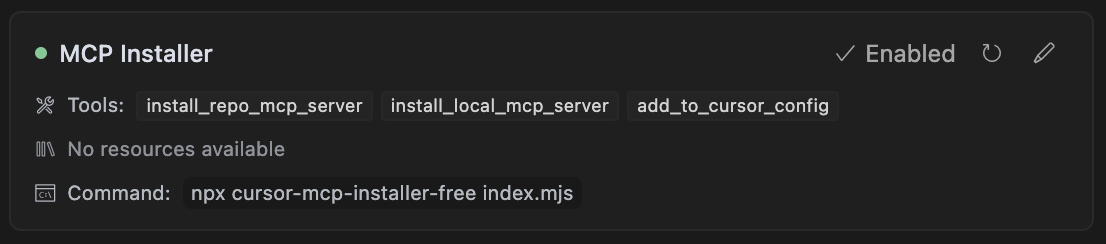
The MCP Installer provides three main tools:
install_repo_mcp_server: Install MCP servers from npm packages or repositoriesinstall_local_mcp_server: Install MCP servers from local directoriesadd_to_cursor_config: Add custom MCP server configurations
Features
- Install MCP servers from npm packages
- Install MCP servers from local directories
- Configure MCP servers for Cursor
- Add custom MCP server configurations
Prerequisites
Before using this tool, you need to have installed:
- Node.js (for npm packages)
- Cursor IDE
Installation
There are several ways to install and use the Cursor MCP Installer:
1. Using npm (Recommended)
npm install -g [email protected]
After installation, add it to your Cursor MCP configuration file:
{
  "mcpServers": {
    "MCP Installer": {
      "command": "cursor-mcp-installer-free",
      "type": "stdio",
      "args": [
        "index.mjs"
      ]
    }
  }
}
2. Using npx (No Installation Required)
You can use npx to run the package without installing it globally:
{
  "mcpServers": {
    "MCP Installer": {
      "command": "npx",
      "type": "stdio",
      "args": [
        "[email protected]",
        "index.mjs"
      ]
    }
  }
}
3. Direct from GitHub
Clone the repository and build it locally:
# Clone the repository
git clone https://github.com/matthewdcage/cursor-mcp-installer.git
cd cursor-mcp-installer

# Install dependencies and build
npm install
npm run build
Then configure Cursor to use your local installation:
{
  "mcpServers": {
    "MCP Installer": {
      "command": "node",
      "type": "stdio",
      "args": [
        "/path/to/cursor-mcp-installer/lib/index.mjs"
      ]
    }
  }
}
Replace /path/to/cursor-mcp-installer with the actual path where you've cloned the repository.
Where is the Cursor MCP Configuration File?
The Cursor MCP configuration file is located at:
- macOS/Linux:
~/.cursor/mcp.json - Windows:
%USERPROFILE%\.cursor\mcp.json
If the file doesn't exist, you can create it with the content from any of the installation methods above.
Path Handling Improvements in v0.1.3
Version 0.1.3 introduces significant improvements to path handling for MCP server installations:
Enhanced Path Resolution
- Properly normalizes both relative and absolute paths
- Handles paths with spaces and special characters
- Ensures consistent path formatting across different operating systems
Better Schema Detection
- Now scans all arguments for schema files, not just the first one
- Supports more schema file extensions (.yaml, .yml, .json, .openapi)
- Properly normalizes schema file paths before passing to servers
Improved Server Discovery
- Added detection of common server entry points in local directories
- Enhanced support for Python-based MCP servers
- Better error reporting for path-related issues
These improvements make the MCP Installer more robust for all types of server installations, especially when dealing with custom file paths, OpenAPI schemas, and local directory installations.
Usage
Once installed, you can use Claude or Cursor to interact with the MCP Installer. Here are some example prompts:
Install an npm package as an MCP server
Install the MCP server named mcp-server-fetch
Install with arguments
Install the @modelcontextprotocol/server-filesystem package as an MCP server. Use ['/home/user/documents'] for the arguments
Install a local MCP server
Install the MCP server at /home/user/projects/my-mcp-server
Install with environment variables
Alternatives



Related Skills
Browse all skillsUI design system toolkit for Senior UI Designer including design token generation, component documentation, responsive design calculations, and developer handoff tools. Use for creating design systems, maintaining visual consistency, and facilitating design-dev collaboration.
Syncs Claude Skills with other AI coding tools like Cursor, Copilot, and Codeium by creating cross-references and shared knowledge bases. Invoke when user wants to leverage skills across multiple tools or create unified AI context.
Answer questions about the AI SDK and help build AI-powered features. Use when developers: (1) Ask about AI SDK functions like generateText, streamText, ToolLoopAgent, embed, or tools, (2) Want to build AI agents, chatbots, RAG systems, or text generation features, (3) Have questions about AI providers (OpenAI, Anthropic, Google, etc.), streaming, tool calling, structured output, or embeddings, (4) Use React hooks like useChat or useCompletion. Triggers on: "AI SDK", "Vercel AI SDK", "generateText", "streamText", "add AI to my app", "build an agent", "tool calling", "structured output", "useChat".
Use when working with the OpenAI API (Responses API) or OpenAI platform features (tools, streaming, Realtime API, auth, models, rate limits, MCP) and you need authoritative, up-to-date documentation (schemas, examples, limits, edge cases). Prefer the OpenAI Developer Documentation MCP server tools when available; otherwise guide the user to enable `openaiDeveloperDocs`.
Guide for building TypeScript CLIs with Bun. Use when creating command-line tools, adding subcommands to existing CLIs, or building developer tooling. Covers argument parsing, subcommand patterns, output formatting, and distribution.
Guide developers through setting up development environments with proper tools, dependencies, and configurations