
EventCatalog
Lets you query your EventCatalog documentation directly from MCP clients like Claude. Find information about domains, services, events, and schemas without manually browsing through your event-driven architecture docs.
Provides a dynamic event catalog server for querying and retrieving architectural metadata, enabling developers to explore complex event-driven system components through predefined tools and resources.
What it does
- Query events and messages in your architecture
- Retrieve service information and ownership details
- Get event schemas and data structures
- Analyze downstream impacts of schema changes
- Browse domain and service relationships
- Search architecture components by keywords
Best for
About EventCatalog
EventCatalog is a community-built MCP server published by event-catalog that provides AI assistants with tools and capabilities via the Model Context Protocol. Explore event-driven architecture metadata easily with EventCatalog, your dynamic server for event discovery and architectural insights. It is categorized under developer tools.
How to install
You can install EventCatalog in your AI client of choice. Use the install panel on this page to get one-click setup for Cursor, Claude Desktop, VS Code, and other MCP-compatible clients. This server runs locally on your machine via the stdio transport.
License
EventCatalog is released under the NOASSERTION license.
📖 EventCatalog - MCP Server
Save time and money by getting insights from your EventCatalog directly from your MCP Client (Claude, Cursor, Windsurf, etc)
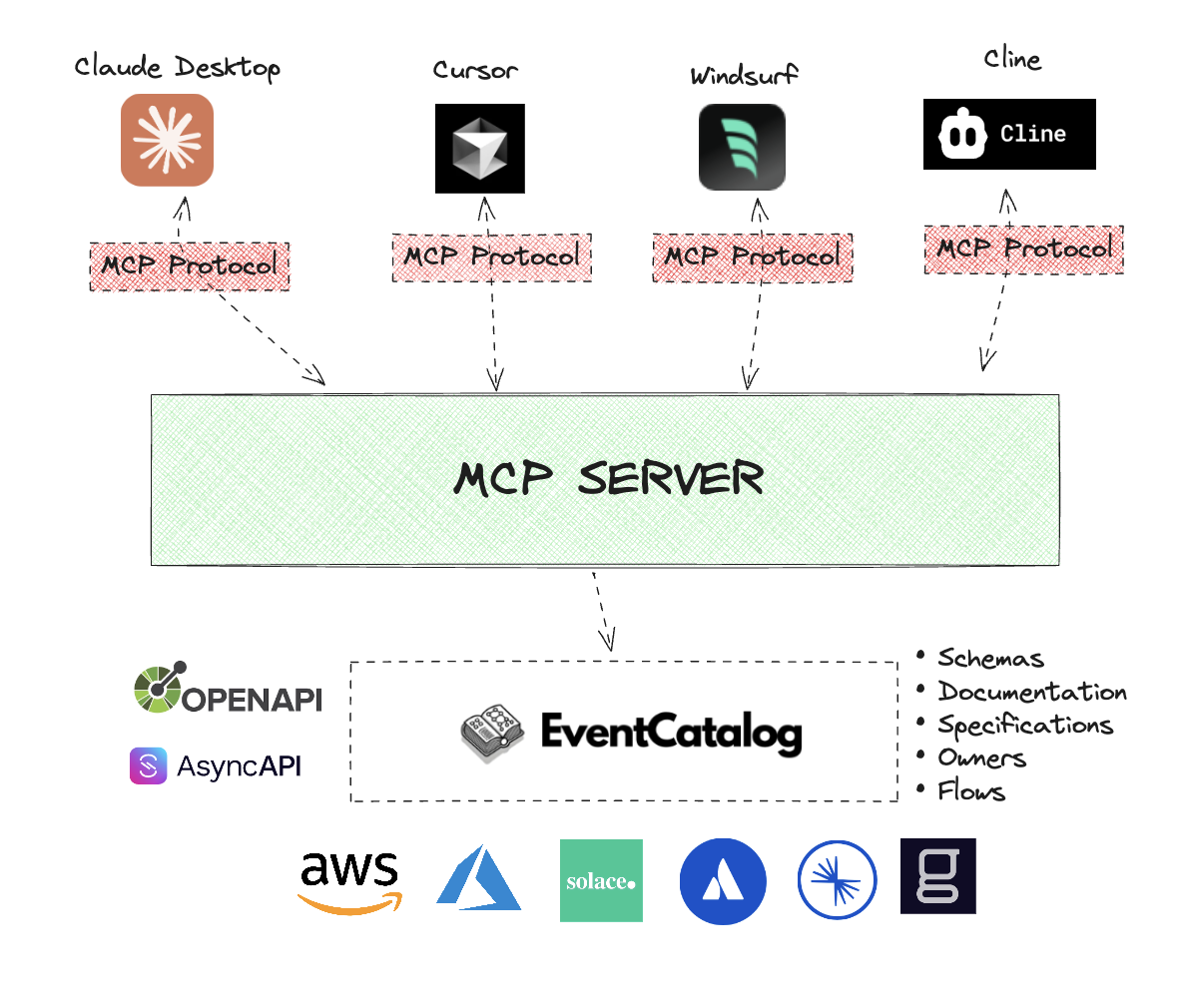
Features: Ask about domains, services and messages. Get answers in seconds. Request schemas, who owns what and much more.
Why EventCatalog MCP Server?
EventCatalog is an Open Source tool that helps you document your event-driven architecture. Using EventCatalog you can document your domains, services and messages, schemas and much more.
Using the EventCatalog MCP Server you can get more value from your EventCatalog by asking questions about your architecture in the tools you already use.
Example questions:
- What events do we have in our architecture?
- Tell me more about the {service} service.
- I want to create a new feature that will send emails when a user signs up, what events do we have in our architecture that are related to user signups?
- Get me the schema for the event
UserCreatedin EventCatalog. - Here is a new version of the
UserCreatedschema, what downstream consumers will be affected by this change?
Rather then digging through your architecture to find the answers you need, you can ask the MCP server directly from your MCP Client.
EventCatalog MCP Features
- 🤖 Connect to any MCP Client (Claude, Cursor, Windsurf, etc)
- 🤖 Run MCP server locally on your machine with one command
- 🤖 Connect to your EventCatalog instances
- 🤖 Ask questions about your architectures
- 🤖 Ask questions about your OpenAPI and AsyncAPI specifications
- 🤖 Ask about domains, services and messages, and much more
- 🤖 Get the schemas for events, queries, commands and services (OpenAPI, AsyncAPI, JSON Schema)
- 🤖 Ask questions about ubiquitous language for any domain and their entities
Getting Started
Installation
First, you need to enable the LLMS.txt feature in your EventCatalog instance.
- Enable the
LLMS.txtfeature in your EventCatalog instance, by configuring youreventcatalog.config.jsfile. - Deploy your EventCatalog instance with the
LLMS.txtfeature enabled.
Next, you will need to get a EventCatalog Scale license key, you can get a 14 day trial license key from EventCatalog Cloud.
Installing via Smithery
To install EventCatalog for Claude Desktop automatically via Smithery:
npx -y @smithery/cli install @event-catalog/mcp-server --client claude
Running as a Docker Container
If you want to run the MCP server as a standalone Docker container (for example, to run it as an HTTP server), see the Docker Deployment Guide.
This is useful for:
- Running the MCP server in production environments
- Deploying as a containerized service
- Running in HTTP mode for integration with multiple clients
- Kubernetes, Docker Swarm, or other container orchestration platforms
Transport Modes
The EventCatalog MCP Server supports two transport modes:
STDIO Mode (Default)
- Uses standard input/output for communication
- Ideal for local development and MCP clients like Claude Desktop and Cursor
- Started automatically when you add the server to your MCP client
- No port exposure needed
- Recommended for: Claude Desktop, Cursor, Windsurf, and other desktop MCP clients
HTTP Mode
- Runs as an HTTP server on a specified port (default: 3000)
- Ideal for production deployments and container environments
- Allows multiple clients to connect to a single server instance
- Includes health check endpoints for monitoring
- Recommended for: Docker deployments, Kubernetes, production environments, and multi-client setups
To use HTTP mode, pass http as the transport parameter:
npx -y @eventcatalog/mcp-server {URL} {LICENSE_KEY} http {PORT}
Or set the MCP_TRANSPORT environment variable to http (see Docker Deployment Guide for details).
Setup MCP Clients
Each MCP client has a different way of adding the MCP server.
You can find some helpful links below to get started.
Adding the MCP server to Claude Desktop
To use this with Claude Desktop, add the following to your claud_desktop_config.json file. The full path on MacOS: ~/Library/Application Support/Claude/claud_desktop_config.json, on Windows: %APPDATA%\Claude\claud_desktop_config.json
{
  "mcpServers": {
    "eventcatalog": {
      "command": "npx",
      "args": [
        "-y",
        "@eventcatalog/mcp-server",
        "https://demo.eventcatalog.dev", // Replace with your EventCatalog URL
        "ABCD-1234-5678-9012-3456-7890" // Replace with your EventCatalog Scale license key
      ]
    }
  }
}
Adding the MCP server to Cursor
Go to Cursor Settings -> MCP Servers -> Add MCP Server.
- Name:
eventcatalog - Command:
npx - Args:
-y @eventcatalog/mcp-server {URL_TO_YOUR_EVENTCATALOG_INSTANCE}
Configuration for your project
You can also create .mcp.json files in your project to configure the MCP server for your project using Cursor.
{
  "mcpServers": {
    "eventcatalog": {
      "command": "npx",
      "args": ["-y", "@eventcatalog/mcp-server", "https://demo.eventcatalog.dev", "ABCD-1234-5678-9012-3456-7890"]
    }
  }
}
You can read more about configuration for your project in the Cursor documentation.
API
Here is a list of all the APIs that the MCP server supports.
Tools
find_resources- Find resources that are available in EventCatalog including services, domains, events, commands, queries, flows, entities, channels, teams, users, and docs
- Supports filtering by type and search terms
- Includes pagination support with cursors
find_resource- Get more information about a service, domain, event, command, query, flow, entity, or channel in EventCatalog using its id and version
- Returns complete resource details including specifications, owners, producers, and consumers
find_owners- Find owners (teams or users) for a domain, service, message, event, command, query, flow, or entity in EventCatalog
- Returns detailed owner information with documentation links
find_producers_and_consumers- Get the producers (sends) and consumers (receives) for services in EventCatalog
- Helps understand message flow and service dependencies
get_schema- Returns the schema for a service (e.g., OpenAPI, AsyncAPI, GraphQL), event, command, or query in EventCatalog
- Supports all major schema formats
review_schema_changes- Reviews schema changes for breaking changes and suggests fixes
- Compares old and new schemas to identify potential issues
- Provides recommendations for handling breaking changes
explain_ubiquitous_language_terms- Explain ubiquitous language terms for a given domain
- Returns definitions and context for domain-specific terminology
create_flow- Create a new flow in EventCatalog given a description of the business workflow
- The tool will check all your resources in EventCatalog to find the best resources to match against the description
- The flow will be created (markdown file) and can be visualized in EventCatalog
eventstorm_to_eventcatalog- Turn a photo of an EventStorm session into an EventCatalog
- Automatically generates domains, services, events, commands, flows, and ubiquitous language terms
- Creates proper folder structure and MDX files with frontmatter
create_eventcatalog- Create a new EventCatalog project from scratch
- Generates all necessary configuration files (package.json, eventcatalog.config.ts)
- Sets up the complete folder structure and initial documentation
Resources
Resources provide quick access to collections of data from your EventCatalog. They can be used to get context about your architecture.
eventcatalog://all- All resources in EventCatalog (messages, domains, services, flows, teams, users, etc.)
- Use this for a complete overview of your architecture
eventcatalog://events- All events in EventCatalog
- Includes event names, versions, and descriptions
eventcatalog://commands- All commands in EventCatalog
- View all command messages in your system
eventcatalog://queries- All queries in EventCatalog
- Access all query messages
eventcatalog://services- All services in EventCatalog
- Complete list of services with their metadata
eventcatalog://domains- All domains in EventCatalog
- View domain boundaries and subdomains
eventcatalog://flows- All flows (business processes) in EventCatalog
- Access workflow definitions and state machines
eventcatalog://teams- All teams in EventCatalog
- View team information and ownership
eventcatalog://users- All users in EventCatalog
- Access user profiles and ownership information
Missing an API?
We are working on adding more APIs to the MCP server. If you need something specific, please [open an issue](https://github.com/eventc
README truncated. View full README on GitHub.
Alternatives



Related Skills
Browse all skillsUI design system toolkit for Senior UI Designer including design token generation, component documentation, responsive design calculations, and developer handoff tools. Use for creating design systems, maintaining visual consistency, and facilitating design-dev collaboration.
Answer questions about the AI SDK and help build AI-powered features. Use when developers: (1) Ask about AI SDK functions like generateText, streamText, ToolLoopAgent, embed, or tools, (2) Want to build AI agents, chatbots, RAG systems, or text generation features, (3) Have questions about AI providers (OpenAI, Anthropic, Google, etc.), streaming, tool calling, structured output, or embeddings, (4) Use React hooks like useChat or useCompletion. Triggers on: "AI SDK", "Vercel AI SDK", "generateText", "streamText", "add AI to my app", "build an agent", "tool calling", "structured output", "useChat".
Use when working with the OpenAI API (Responses API) or OpenAI platform features (tools, streaming, Realtime API, auth, models, rate limits, MCP) and you need authoritative, up-to-date documentation (schemas, examples, limits, edge cases). Prefer the OpenAI Developer Documentation MCP server tools when available; otherwise guide the user to enable `openaiDeveloperDocs`.
Guide for building TypeScript CLIs with Bun. Use when creating command-line tools, adding subcommands to existing CLIs, or building developer tooling. Covers argument parsing, subcommand patterns, output formatting, and distribution.
Guide developers through setting up development environments with proper tools, dependencies, and configurations
Integrate Vercel AI SDK applications with You.com tools (web search, AI agent, content extraction). Use when developer mentions AI SDK, Vercel AI SDK, generateText, streamText, or You.com integration with AI SDK.