
GoWeb3
Discover Web3 events, news, and regional analysis with GoWeb3.fyi – your source for ethnews and Web3 happenings by region and date.
Provides access to Web3 events and news from GoWeb3.fyi through a proxy bridge that enables searching events by region and month for discovering Web3 happenings and analyzing regional ecosystems.
About GoWeb3
GoWeb3 is a community-built MCP server published by roadahead1 that provides AI assistants with tools and capabilities via the Model Context Protocol. Discover Web3 events, news, and regional analysis with GoWeb3.fyi – your source for ethnews and Web3 happenings by region and date. It is categorized under analytics data.
How to install
You can install GoWeb3 in your AI client of choice. Use the install panel on this page to get one-click setup for Cursor, Claude Desktop, VS Code, and other MCP-compatible clients. This server supports remote connections over HTTP, so no local installation is required.
License
GoWeb3 is released under the MIT license. This is a permissive open-source license, meaning you can freely use, modify, and distribute the software.
Web3 Information MCP Server
Introduction
This is a Model Context Protocol (MCP) server that provides access to the Web3 events and news from GoWeb3.fyi.
It allows MCP-enabled AI assistants, other applications to retrieve most important information directly via the MCP interface.
Available Tools
The GoWeb3.fyi MCP server provides the following tools:
- search_events_by_region: Searches for events in the database based on a provided region.
- search_events_by_month: Searches for events in the database based on a provided month.
Available Resources
The GoWeb3.fyi MCP server provides the following resources:
- get_available_regions: Lists valid regions to be used in the search-by-region tool.
- get_available_months: Lists valid month to be used in the search-by-month tool.
Setup
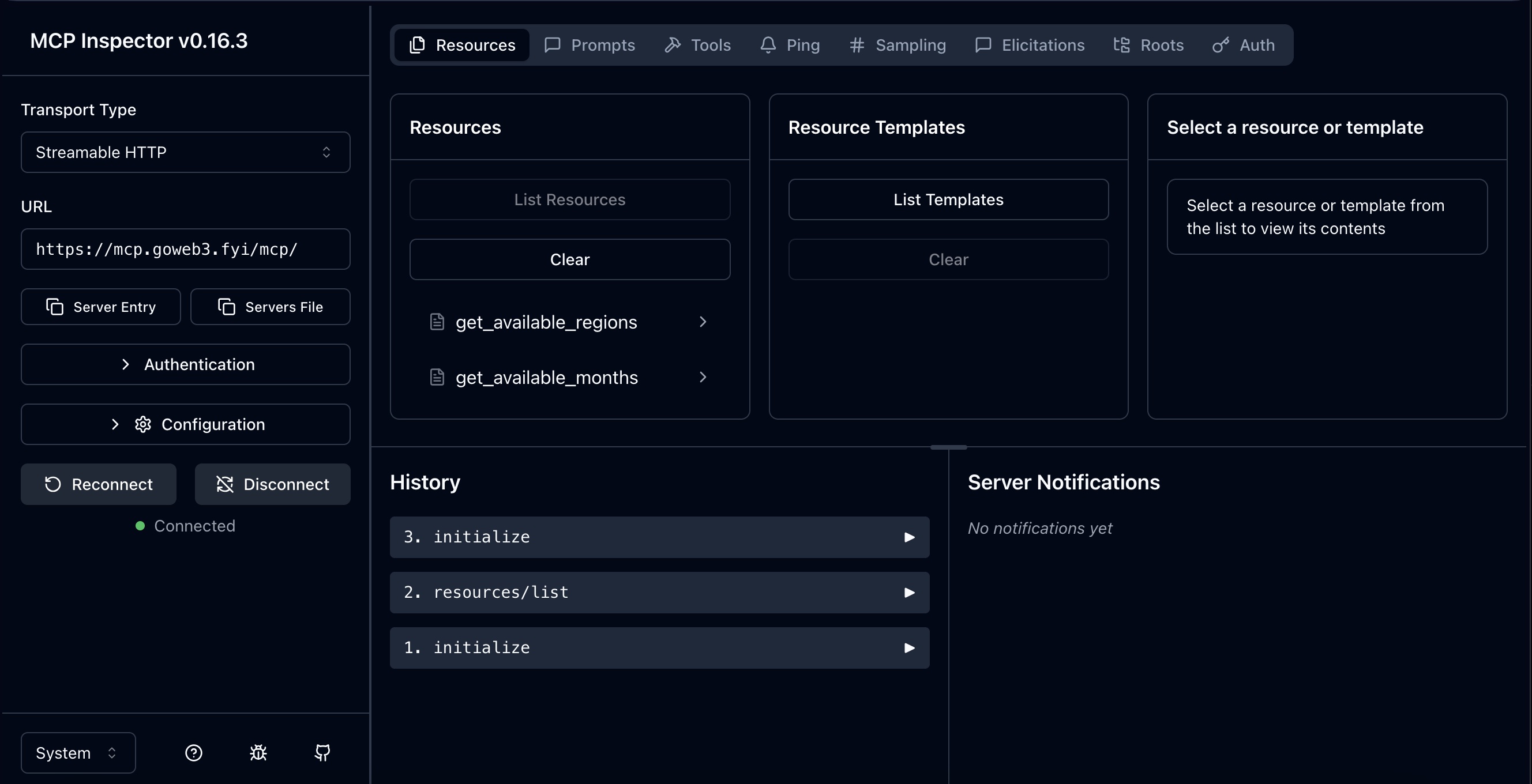
The MCP server could be directly accessed by connecting a mcp-enabled AI assistant or other application to GoWeb3 MCP Server at https://mcp.goweb3.fyi/mcp.
For example, the MCP Inspector setup is shown in the picture below:
To access the server locally one could run a local-to-remote MCP server bridge - the python example is provided in web3_mcp_local_server.py.
Alternatives



Related Skills
Browse all skillsAnalyze Google Analytics data, review website performance metrics, identify traffic patterns, and suggest data-driven improvements. Use when the user asks about analytics, website metrics, traffic analysis, conversion rates, user behavior, or performance optimization.
Transform data into compelling narratives using visualization, context, and persuasive structure. Use when presenting analytics to stakeholders, creating data reports, or building executive presentations.
Advanced content and topic research skill that analyzes trends across Google Analytics, Google Trends, Substack, Medium, Reddit, LinkedIn, X, blogs, podcasts, and YouTube to generate data-driven article outlines based on user intent analysis
YouTube Data API v3 analytics toolkit. Analyze YouTube channels, videos, and search results. Use when the user asks to: check YouTube channel stats, analyze video performance, compare channels, search for videos, get subscriber counts, view engagement metrics, find trending videos, get channel uploads, or analyze YouTube competition. Requires a YouTube Data API v3 key from Google Cloud Console.
Expert data scientist for advanced analytics, machine learning, and statistical modeling. Handles complex data analysis, predictive modeling, and business intelligence. Use PROACTIVELY for data analysis tasks, ML modeling, statistical analysis, and data-driven insights.
Comprehensive backend development guide for Langfuse's Next.js 14/tRPC/Express/TypeScript monorepo. Use when creating tRPC routers, public API endpoints, BullMQ queue processors, services, or working with tRPC procedures, Next.js API routes, Prisma database access, ClickHouse analytics queries, Redis queues, OpenTelemetry instrumentation, Zod v4 validation, env.mjs configuration, tenant isolation patterns, or async patterns. Covers layered architecture (tRPC procedures → services, queue processors → services), dual database system (PostgreSQL + ClickHouse), projectId filtering for multi-tenant isolation, traceException error handling, observability patterns, and testing strategies (Jest for web, vitest for worker).