
Nostrdb
Provides access to locally stored Nostr social network data through nostrdb database queries. Works with your existing Notedeck data to search and analyze Nostr posts and events.
Integrates with nostrdb to enable local Nostr data querying and analysis.
What it does
- Query local Nostr database with custom parameters
- Get database statistics and metadata
- Search through cached Nostr posts and events
- Analyze local Nostr data patterns
Best for
About Nostrdb
Nostrdb is a community-built MCP server published by damus-io that provides AI assistants with tools and capabilities via the Model Context Protocol. Nostrdb — query and analyze local Nostr data with fast, private integrations for developers and researchers. It is categorized under databases, developer tools. This server exposes 2 tools that AI clients can invoke during conversations and coding sessions.
How to install
You can install Nostrdb in your AI client of choice. Use the install panel on this page to get one-click setup for Cursor, Claude Desktop, VS Code, and other MCP-compatible clients. This server runs locally on your machine via the stdio transport.
License
Nostrdb is released under the MIT license. This is a permissive open-source license, meaning you can freely use, modify, and distribute the software.
Tools (2)
Get statistics of the NDB.
Query the NDB with specific parameters.
nostrdb-mcp
A Model Context Protocol server for nostrdb.
What?
MCP is a protocol that enables LLMs to interface with tools and systems. This server enables LLMs to use the ndb nostrdb command line tool to make local nostr queries.
By default, it uses your Notedeck nostrdb directory so that it can search notes your notedeck has seen.
Install
Make sure you have ndb on your path by compiling it via the nostrdb repo by typing make ndb and copying it to your path.
Goose
You can configure goose to use this tool:
$ goose configure
When adding a provider, use: npx -y nostrdb-mcp
You can create a temporary session to try it out like so:
$ goose session --with-extension `npm -y nostrdb-mcp`
Example
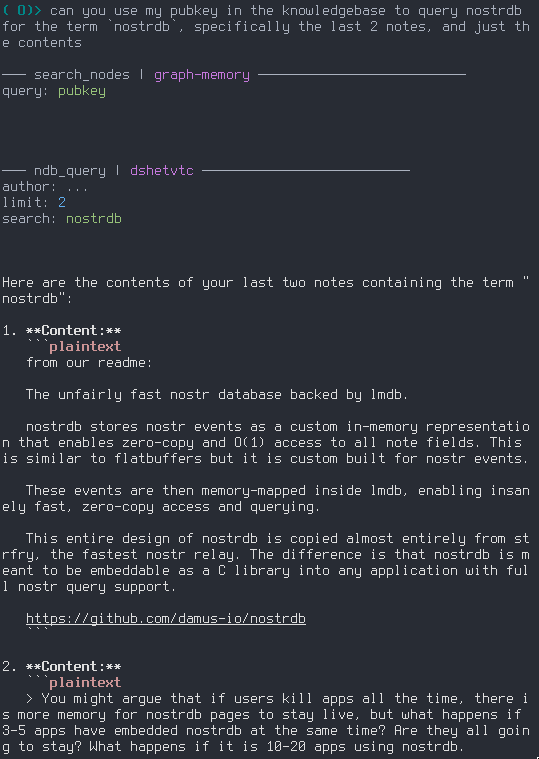
Alternatives



Related Skills
Browse all skillsUI design system toolkit for Senior UI Designer including design token generation, component documentation, responsive design calculations, and developer handoff tools. Use for creating design systems, maintaining visual consistency, and facilitating design-dev collaboration.
Modern web development expertise covering React, Node.js, databases, and full-stack architecture. Use when: building web applications, developing APIs, creating frontends, setting up databases, deploying web apps, or when user mentions React, Next.js, Express, REST API, GraphQL, MongoDB, PostgreSQL, or full-stack development.
Answer questions about the AI SDK and help build AI-powered features. Use when developers: (1) Ask about AI SDK functions like generateText, streamText, ToolLoopAgent, embed, or tools, (2) Want to build AI agents, chatbots, RAG systems, or text generation features, (3) Have questions about AI providers (OpenAI, Anthropic, Google, etc.), streaming, tool calling, structured output, or embeddings, (4) Use React hooks like useChat or useCompletion. Triggers on: "AI SDK", "Vercel AI SDK", "generateText", "streamText", "add AI to my app", "build an agent", "tool calling", "structured output", "useChat".
Find, connect, and use MCP tools and skills via the Smithery CLI. Use when the user searches for new tools or skills, wants to discover integrations, connect to an MCP, install a skill, or wants to interact with an external service (email, Slack, Discord, GitHub, Jira, Notion, databases, cloud APIs, monitoring, etc.).
Use when working with the OpenAI API (Responses API) or OpenAI platform features (tools, streaming, Realtime API, auth, models, rate limits, MCP) and you need authoritative, up-to-date documentation (schemas, examples, limits, edge cases). Prefer the OpenAI Developer Documentation MCP server tools when available; otherwise guide the user to enable `openaiDeveloperDocs`.
Guide for building TypeScript CLIs with Bun. Use when creating command-line tools, adding subcommands to existing CLIs, or building developer tooling. Covers argument parsing, subcommand patterns, output formatting, and distribution.