
Windows Screenshots
Enables Claude to access Windows screenshots directly from WSL2 environments by automatically detecting screenshot directories and providing tools to list and retrieve screenshot files.
Provides access to Windows screenshots from WSL2 environments by automatically detecting screenshot directories and offering tools to list recent screenshots with metadata, retrieve specific files as paths or base64 content, and display configured directories.
What it does
- List recent Windows screenshots with metadata
- Retrieve screenshot files as base64 content
- Auto-detect Windows screenshot directory locations
- Display configured screenshot directories
- Access screenshots across WSL2 and native Windows
Best for
About Windows Screenshots
Windows Screenshots is a community-built MCP server published by rubinsh that provides AI assistants with tools and capabilities via the Model Context Protocol. Easily access and manage Windows Screenshots from WSL2. List and retrieve screenshots with metadata, paths, or base64 content. It is categorized under file systems.
How to install
You can install Windows Screenshots in your AI client of choice. Use the install panel on this page to get one-click setup for Cursor, Claude Desktop, VS Code, and other MCP-compatible clients. This server runs locally on your machine via the stdio transport.
License
Windows Screenshots is released under the MIT license. This is a permissive open-source license, meaning you can freely use, modify, and distribute the software.
MCP Windows Screenshots


An MCP (Model Context Protocol) server that enables Claude to access Windows screenshots from WSL2. Perfect for seamlessly sharing screenshots with Claude Code without manual file navigation.
Why This Tool?
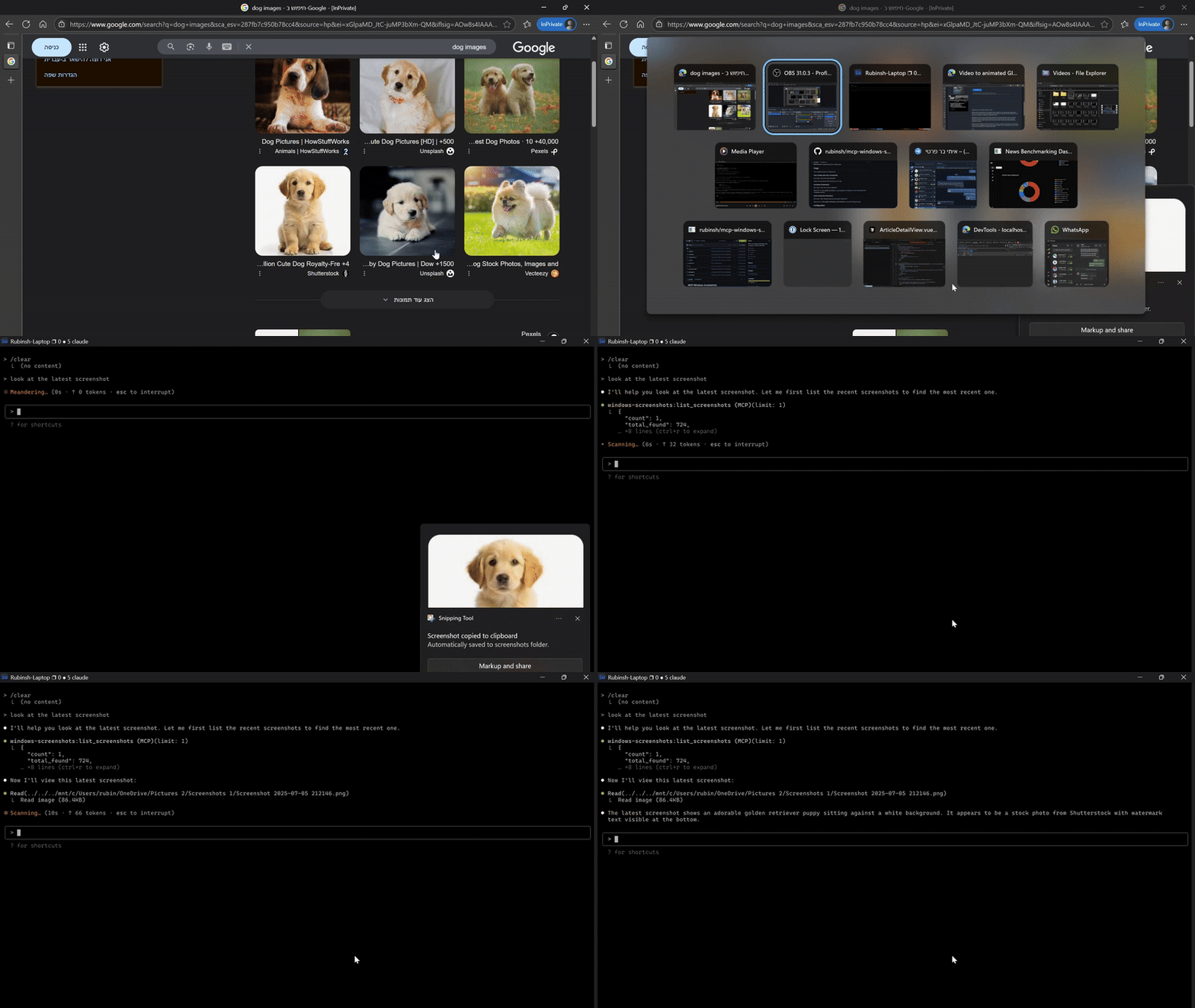
When using Claude Code cli in WSL2 or in Cursor/VSCode, sharing Windows screenshots requires navigating complex file paths like /mnt/c/Users/... or dragging the image to the terminal.
Also, what if want to share the last 4 screenshots with Claude? this can become very cubersome.
This tool simplifies the process to just:
- Take a screenshot on Windows (Win+Shift+S)
- Ask Claude to show your latest screenshot/s
- Claude instantly accesses and displays it
No more copy-pasting paths or navigating directories!
Key Features
- Auto-detection: Automatically detects your Windows Screenshots folder location from the registry
- Cross-platform: Works in both WSL2 and native Windows environments
- Smart defaults: Falls back to common screenshot locations if custom paths aren't found
- Zero configuration: Works out of the box for most users
Prerequisites
- Windows 10/11 (with or without WSL2)
- Node.js 18+
- Claude Code CLI installed
Installation
Run this single command in your terminal (works in WSL2, Windows Terminal, PowerShell, or Command Prompt):
claude mcp add windows-screenshots -s user -- npx mcp-windows-screenshots@latest
That's it! Restart Claude Code and you're ready to go.
The tool will automatically:
- Detect your environment (WSL2 or Windows)
- Find your Windows Screenshots folder from the registry
- Configure the appropriate paths
Usage
Once installed, Claude can use these tools:
View a Screenshot
Ask Claude: "Look at the latest screenshot"
Claude will automatically find it and look at the image.
List Recent Screenshots
Ask Claude: "Show me my latest screenshots"
Claude will display your recent screenshots with timestamps and sizes.
Check Screenshot Directories
Ask Claude: "Which directories are you checking for screenshots?"
Claude will show all configured paths.
How It Works
The tool automatically:
- Detects your environment (WSL2 vs native Windows)
- Queries Windows registry for your actual Screenshots folder location
- Searches common locations as fallback:
- Your configured Screenshots folder (from Windows settings)
- Pictures/Screenshots
- OneDrive Pictures/Screenshots
- Desktop
- Documents/Screenshots
- Temp folders
Troubleshooting
No screenshots found
- Ask Claude to "list screenshot directories" to see which paths are being searched
- Ensure your screenshots are saved in one of the searched directories
- If your screenshots are in a custom location, see Advanced Configuration below
Tool not available
- Restart Claude Code after installation
- Run
claude mcp listto verify the server is installed - Ensure you used
-s userwhen adding the server
Advanced Configuration
Custom Screenshot Directories
If your screenshots are saved in a non-standard location, you can specify custom directories:
WSL2 with custom paths:
claude mcp add windows-screenshots -s user \
  -e "MCP_SCREENSHOT_DIRS=/mnt/c/Users/john/CustomFolder;/mnt/c/Users/john/Desktop" \
  -- npx mcp-windows-screenshots@latest
Windows with custom paths:
claude mcp add windows-screenshots -s user -e "MCP_SCREENSHOT_DIRS=C:\Users\john\CustomFolder;C:\Users\john\Desktop" -- npx mcp-windows-screenshots@latest
Environment Variables
WINDOWS_USERNAME: Override the auto-detected Windows usernameMCP_SCREENSHOT_DIRS: Specify custom screenshot directories (semicolon-separated for multiple paths)
Manual Username Configuration
If the auto-detection doesn't find the correct username:
WSL2:
claude mcp add windows-screenshots -s user \
  -e "WINDOWS_USERNAME=YourWindowsUsername" \
  -- npx mcp-windows-screenshots@latest
Windows:
claude mcp add windows-screenshots -s user -e "WINDOWS_USERNAME=YourWindowsUsername" -- npx mcp-windows-screenshots@latest
Development
To contribute or modify this tool:
git clone https://github.com/rubinsh/mcp-windows-screenshots.git
cd mcp-windows-screenshots
npm install
npm run build
License
MIT © rubinsh
Alternatives


Related Skills
Browse all skillsProcess and generate multimedia content using Google Gemini API. Capabilities include analyze audio files (transcription with timestamps, summarization, speech understanding, music/sound analysis up to 9.5 hours), understand images (captioning, object detection, OCR, visual Q&A, segmentation), process videos (scene detection, Q&A, temporal analysis, YouTube URLs, up to 6 hours), extract from documents (PDF tables, forms, charts, diagrams, multi-page), generate images (text-to-image, editing, composition, refinement). Use when working with audio/video files, analyzing images or screenshots, processing PDF documents, extracting structured data from media, creating images from text prompts, or implementing multimodal AI features. Supports multiple models (Gemini 2.5/2.0) with context windows up to 2M tokens.
This skill should be used when working on Godot Engine projects. It provides specialized knowledge of Godot's file formats (.gd, .tscn, .tres), architecture patterns (component-based, signal-driven, resource-based), common pitfalls, validation tools, code templates, and CLI workflows. The `godot` command is available for running the game, validating scripts, importing resources, and exporting builds. Use this skill for tasks involving Godot game development, debugging scene/resource files, implementing game systems, or creating new Godot components.
Convert Markdown files to HTML similar to `marked.js`, `pandoc`, `gomarkdown/markdown`, or similar tools; or writing custom script to convert markdown to html and/or working on web template systems like `jekyll/jekyll`, `gohugoio/hugo`, or similar web templating systems that utilize markdown documents, converting them to html. Use when asked to "convert markdown to html", "transform md to html", "render markdown", "generate html from markdown", or when working with .md files and/or web a templating system that converts markdown to HTML output. Supports CLI and Node.js workflows with GFM, CommonMark, and standard Markdown flavors.
Email has the highest ROI of any marketing channel. $36 for every $1 spent. Yet most startups treat it as an afterthought - bulk blasts, no personalization, landing in spam folders. This skill covers transactional email that works, marketing automation that converts, deliverability that reaches inboxes, and the infrastructure decisions that scale. Use when: keywords, file_patterns, code_patterns.
Python library for working with geospatial vector data including shapefiles, GeoJSON, and GeoPackage files. Use when working with geographic data for spatial analysis, geometric operations, coordinate transformations, spatial joins, overlay operations, choropleth mapping, or any task involving reading/writing/analyzing vector geographic data. Supports PostGIS databases, interactive maps, and integration with matplotlib/folium/cartopy. Use for tasks like buffer analysis, spatial joins between datasets, dissolving boundaries, clipping data, calculating areas/distances, reprojecting coordinate systems, creating maps, or converting between spatial file formats.
Build document Q&A and searchable knowledge bases with Google Gemini File Search - fully managed RAG with automatic chunking, embeddings, and citations. Upload 100+ file formats (PDF, Word, Excel, code), configure semantic search, and query with natural language.Use when: building document Q&A systems, creating searchable knowledge bases, implementing semantic search without managing embeddings, indexing large document collections (100+ formats), or troubleshooting document immutability errors (delete+re-upload required), storage quota issues (3x input size for embeddings), chunking configuration (500 tokens/chunk recommended), metadata limits (20 key-value pairs max), indexing cost surprises ($0.15/1M tokens one-time), operation polling timeouts (wait for done: true), force delete errors, or model compatibility (Gemini 2.5 Pro/Flash only).