
OracleDB
Connects LLMs to Oracle Database, allowing them to discover tables/columns and execute SQL queries through natural language conversations.
Provides a bridge to Oracle Database, enabling dynamic table and column discovery, secure query execution, and metadata retrieval through natural language interactions for data analysts and developers.
What it does
- Discover Oracle database tables and columns dynamically
- Execute SQL queries securely on Oracle databases
- Retrieve database metadata and schema information
- Generate SQL statements from natural language prompts
- Filter accessible tables and columns with whitelist controls
Best for
About OracleDB
OracleDB is a community-built MCP server published by rahgadda that provides AI assistants with tools and capabilities via the Model Context Protocol. OracleDB bridges Oracle Database and cloud integrations, enabling secure queries, dynamic metadata discovery, and seamless data analysis workflows. It is categorized under databases.
How to install
You can install OracleDB in your AI client of choice. Use the install panel on this page to get one-click setup for Cursor, Claude Desktop, VS Code, and other MCP-compatible clients. This server runs locally on your machine via the stdio transport.
License
OracleDB is released under the Apache-2.0 license. This is a permissive open-source license, meaning you can freely use, modify, and distribute the software.
OracleDB MCP Server

Overview
- This project will install
MCP - Model Context Protocol Server, that provides configured Oracle Database Table/Columns as context to LLM's. - Using this we can enable LLMs to interact with Oracle Database, Generate SQL Statements and Return Results using LLM prompts.
Installation
- Install package
pip install oracledb_mcp_server - Create .env in a folder with minimum value of
Oracle DB Connection String. Sample file available here - Test
oracledb_mcp_serverserver usinguv run oracledb_mcp_serverfrom the above folder.
Claud Desktop
- Configuration details for Claud Desktop
{
  "mcpServers": {
    "oracledb_mcp_server":{
      "command": "uv",
      "args": ["run","oracledb_mcp_server"],
      "env": {
          "DEBUG":"True",
          "COMMENT_DB_CONNECTION_STRING":"oracle+oracledb://USERNAME:PASSWORD@IP:PORT/?service_name=SERVICENAME",
          "DB_CONNECTION_STRING":"oracle+oracledb://USERNAME:PASSWORD@IP:PORT/?service_name=SERVICENAME",
          "TABLE_WHITE_LIST":"ACCOUNTS,CUS_ACC_RELATIONS,CUSTOMERS",
          "COLUMN_WHITE_LIST":"ACCOUNTS.ACC_AAD_ID,CUS_ACC_RELATIONS.CAR_CUS_ID,CUS_ACC_RELATIONS.CAR_AAD_ID,CUSTOMERS.CUS_ID"
      }
    }
  }
}
Configuration
- List of available environment variables
DEBUG: Enable debug logging (optional default is False)COMMENT_DB_CONNECTION_STRING: Oracle DB connection String for comments. (required)DB_CONNECTION_STRING: Oracle DB connection String for execution of queries. (required)TABLE_WHITE_LIST: White Listed table names in list format ["table1", "table2"] (required)COLUMN_WHITE_LIST: White Listed table-column names in list format ["table.column1", "table.column2"] (required)QUERY_LIMIT_SIZE: Default value is 10 records if not provided(optional default is 10)
Interceptor
npx @modelcontextprotocol/inspector uv --directory "D:\\MyDev\\mcp\\oracledb_mcp_server" run -m oracledb_mcp_server
Contributing
Contributions are welcome.
Please feel free to submit a Pull Request.
License
This project is licensed under the terms of the MIT license.
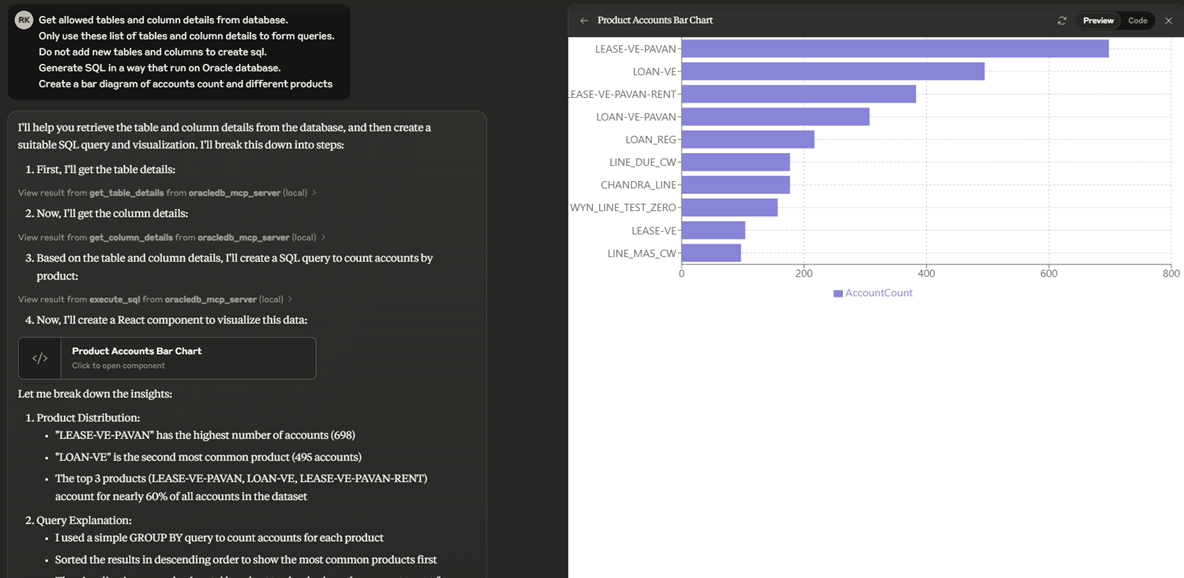
Demo
Github Stars
Alternatives



Related Skills
Browse all skillsConduct comprehensive, systematic literature reviews using multiple academic databases (PubMed, arXiv, bioRxiv, Semantic Scholar, etc.). This skill should be used when conducting systematic literature reviews, meta-analyses, research synthesis, or comprehensive literature searches across biomedical, scientific, and technical domains. Creates professionally formatted markdown documents and PDFs with verified citations in multiple citation styles (APA, Nature, Vancouver, etc.).
Comprehensive guide for PostgreSQL psql - the interactive terminal client for PostgreSQL. Use when connecting to PostgreSQL databases, executing queries, managing databases/tables, configuring connection options, formatting output, writing scripts, managing transactions, and using advanced psql features for database administration and development.
Modern web development expertise covering React, Node.js, databases, and full-stack architecture. Use when: building web applications, developing APIs, creating frontends, setting up databases, deploying web apps, or when user mentions React, Next.js, Express, REST API, GraphQL, MongoDB, PostgreSQL, or full-stack development.
Autonomous biomedical AI agent framework for executing complex research tasks across genomics, drug discovery, molecular biology, and clinical analysis. Use this skill when conducting multi-step biomedical research including CRISPR screening design, single-cell RNA-seq analysis, ADMET prediction, GWAS interpretation, rare disease diagnosis, or lab protocol optimization. Leverages LLM reasoning with code execution and integrated biomedical databases.
Notion workspace integration. Use when user wants to read/write Notion pages, search databases, create tasks, or sync content with Notion.
Full Confluence Cloud REST API v2 skill (pages, spaces, folders, databases, whiteboards, comments, labels, tasks, properties, etc.) with basic/OAuth auth, pagination, and migration from confluence-cli.