
Siri Shortcuts
Connects to macOS Shortcuts app to list and run your custom automation workflows from AI assistants. Dynamically generates tools for each shortcut you have installed.
Integrates with macOS Shortcuts to dynamically expose and execute user-defined automation workflows through generated tools.
What it does
- List all available macOS shortcuts
- Run shortcuts with optional input parameters
- Open shortcuts in the Shortcuts app
- Generate dynamic tools for each shortcut
- Pass text or file inputs to shortcuts
Best for
About Siri Shortcuts
Siri Shortcuts is a community-built MCP server published by dvcrn that provides AI assistants with tools and capabilities via the Model Context Protocol. Access mac keyboard shortcuts for screen capture and automate workflows with Siri Shortcuts. Streamline hotkey screenshot mac tasks easily. It is categorized under productivity, developer tools.
How to install
You can install Siri Shortcuts in your AI client of choice. Use the install panel on this page to get one-click setup for Cursor, Claude Desktop, VS Code, and other MCP-compatible clients. This server runs locally on your machine via the stdio transport.
License
Siri Shortcuts is released under the GPL-3.0 license.
Siri Shortcuts MCP Server
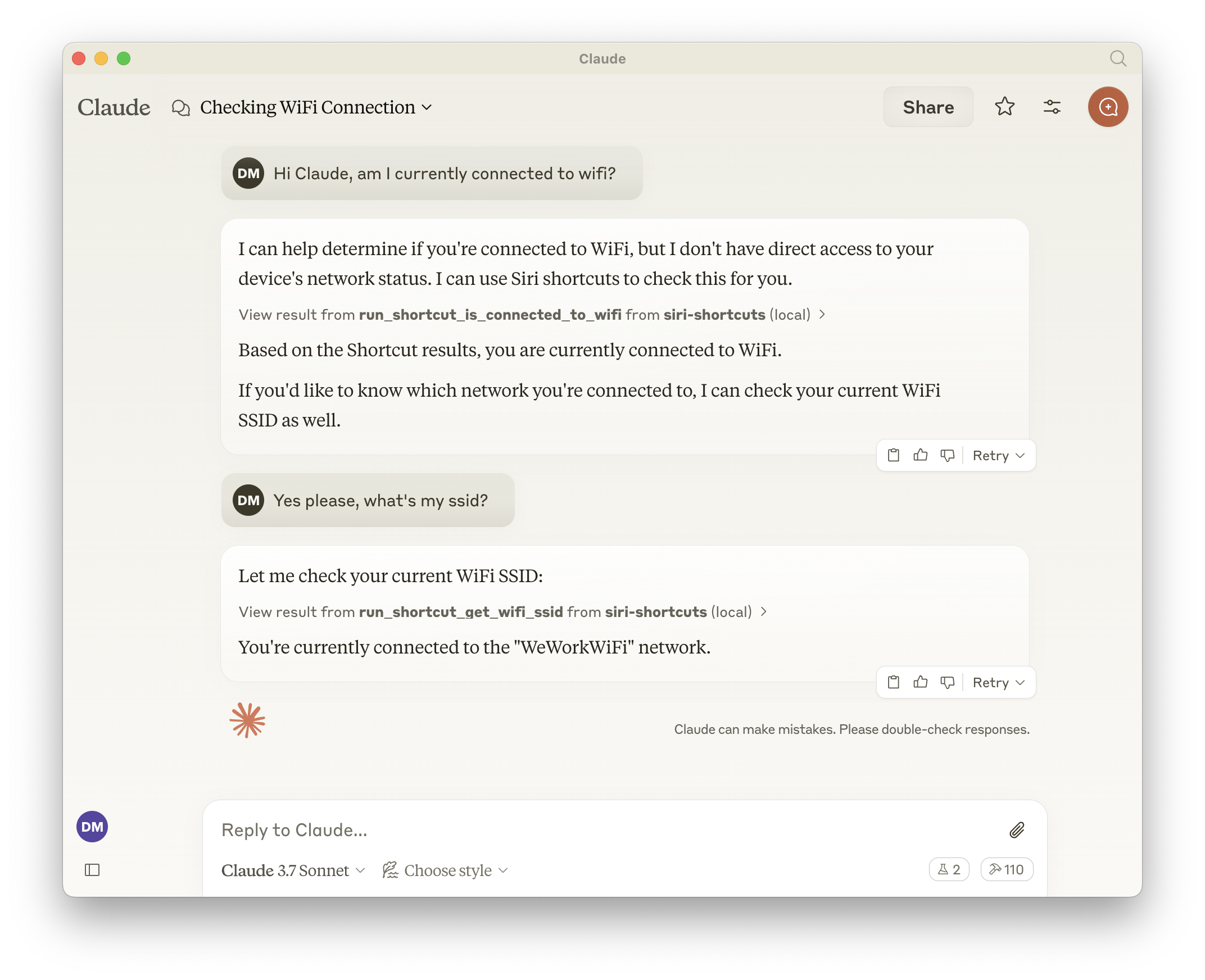
This MCP server provides access to Siri shortcuts functionality via the Model Context Protocol (MCP). It allows listing, opening, and running shortcuts from the macOS Shortcuts app.
Features
- Exposes all shortcuts, meaning the LLM can call anything that is available in the Shortcuts app.
- List all available shortcuts
- Open shortcuts in the Shortcuts app
- Run shortcuts with optional input parameters
- Dynamically generated tools for each available shortcut
Tools
Base Tools
-
list_shortcuts- Lists all available Siri shortcuts on the system
- No input required
- Returns: Array of shortcut names
{ "shortcuts": [{ "name": "My Shortcut 1" }, { "name": "My Shortcut 2" }] } -
open_shortcut- Opens a shortcut in the Shortcuts app
- Input:
name(string): Name of the shortcut to open
-
run_shortcut- Runs a shortcut with optional input
- Input:
name(string): Name or identifier (UUID) of the shortcut to runinput(string, optional): Text input or filepath to pass to the shortcut
Dynamic Tools
The server automatically generates additional tools for each available shortcut in the format:
- Tool name:
run_shortcut_[sanitized_shortcut_name] - Description: Runs the specific shortcut
- Input:
input(string, optional): Text input or filepath to pass to the shortcut
Configuration
The server supports the following environment variables:
GENERATE_SHORTCUT_TOOLS(default:true): When set tofalse, disables the generation of dynamic shortcut tools. Only the base tools (list_shortcuts,open_shortcut,run_shortcut) will be available.INJECT_SHORTCUT_LIST(default:false): When set totrue, injects the list of available shortcuts into therun_shortcuttool description to help the LLM understand which shortcuts are available.
Usage with Claude
Add to your Claude configuration:
{
  "mcpServers": {
    "siri-shortcuts": {
      "command": "npx",
      "args": ["mcp-server-siri-shortcuts"],
      "env": {
        "GENERATE_SHORTCUT_TOOLS": "true",
        "INJECT_SHORTCUT_LIST": "false"
      }
    }
  }
}
Implementation Details
- Uses the macOS
shortcutsCLI command under the hood - Sanitizes shortcut names for tool naming compatibility
- Supports both direct text input and file-based input
- Returns shortcut output when available
- Implements standard MCP error handling
Alternatives



Related Skills
Browse all skillsUI design system toolkit for Senior UI Designer including design token generation, component documentation, responsive design calculations, and developer handoff tools. Use for creating design systems, maintaining visual consistency, and facilitating design-dev collaboration.
Answer questions about the AI SDK and help build AI-powered features. Use when developers: (1) Ask about AI SDK functions like generateText, streamText, ToolLoopAgent, embed, or tools, (2) Want to build AI agents, chatbots, RAG systems, or text generation features, (3) Have questions about AI providers (OpenAI, Anthropic, Google, etc.), streaming, tool calling, structured output, or embeddings, (4) Use React hooks like useChat or useCompletion. Triggers on: "AI SDK", "Vercel AI SDK", "generateText", "streamText", "add AI to my app", "build an agent", "tool calling", "structured output", "useChat".
PERSONAL APP ARCHITECT - Strategic development orchestrator for personal productivity applications. Analyzes project context, makes architectural decisions for single-developer projects, delegates to specialized skills, and ensures alignment between user experience goals and technical implementation. Optimized for personal apps targeting 10-100 users.
Creates educational Teams channel posts for internal knowledge sharing about Claude Code features, tools, and best practices. Applies when writing posts, announcements, or documentation to teach colleagues effective Claude Code usage, announce new features, share productivity tips, or document lessons learned. Provides templates, writing guidelines, and structured approaches emphasizing concrete examples, underlying principles, and connections to best practices like context engineering. Activates for content involving Teams posts, channel announcements, feature documentation, or tip sharing.
Use when working with the OpenAI API (Responses API) or OpenAI platform features (tools, streaming, Realtime API, auth, models, rate limits, MCP) and you need authoritative, up-to-date documentation (schemas, examples, limits, edge cases). Prefer the OpenAI Developer Documentation MCP server tools when available; otherwise guide the user to enable `openaiDeveloperDocs`.
Guide for building TypeScript CLIs with Bun. Use when creating command-line tools, adding subcommands to existing CLIs, or building developer tooling. Covers argument parsing, subcommand patterns, output formatting, and distribution.